Middle English Word of the Moment

Showing posts with label gender. Show all posts

Monday, January 4, 2010

The fiend as God’s sergeant (part 2/2)

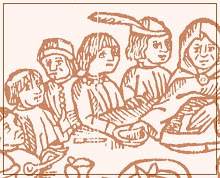
And if the fiend functions as God’s – executor, as it were – carrying out God’s will to the greater glory of the saints while managing to be evil himself (because apparently God has great PR officers), what can we say about these lads?  This is the torture and mastectomy of St Agatha, and I think I may venture to hypothesise that the two at her with pliers are EVILEVILEVIL. Look at their faces – they’re approaching the fiendish themselves[1].

Bibl. Nationale, MS n. a. fr. 16251 fol 87v. Le Livre d'images de Madame Marie, c. 1300. Image taken from Caviness 82.

Hassig has written a chapter on specific details of mediaeval portrayals of Jews/monsters/others/foreigners/devils, all of which elide rather tellingingly at some point.  If I recall[2], there were several things that functioned most strongly in depicting evilother, among them distorted faces, grimaces, crouching posture, tightly curled hair and dark skin.  All of these features are not only present in these unpleasant-looking lads, but accentuated by contrast in every case to the serene, upright, very pale figure between them. So they are associated, not only by narrative function but by visual language, with the actions of the devil.  Standing in for him in the physical performance of Agatha’s martyrdom, they take on physical attributes associated with him – but also, of course, with themselves as ethnically other.

So Christianity’s tendency to create enemies [3] comes in handy here – we have a sliding scale between foreign and devil, between not-us and persecutor and enemy of God, where the only difference between foreigner, pagan, idol, demon and Satan is  of degree.


As the corollary to this, what does Agatha resemble in this picture? Well, in context, that’s rather obvious – who stands around looking bright and benevolent while surrounded by tormentors, with arms stretched out to either side of his head?  And is a complete contrast to devils? In case we missed the similarity, she has her convenient halo to point it out.  There is also a clear sexual difference – she is pure and white and fully clothed (save where they have exposed her body for humiliation and torture) with skirts to the ground, while their legs are bared and the violating instruments are held in a suspiciously phallic position.

Physically, she is approaching (literally) Christ – she is raised above her tormentors, as if halfway to heaven.  And alright, so she has breasts and that’s not entirely Christ-like – but hey, her tormentors are (sergeant-like) removing those for her, so that won’t be a problem for much longer.   Remove those curves, and she would be almost entirely masculine in appearance. 

Of course saints are often depicted as resembling Christ, or rather partaking of the same visual code of virtue and holiness, just as the torturers resemble the devil. But a female saint is visually farther from Christ to begin with, and it’s hardly illogical that she should become masculinised in depiction in the process of approaching him[4].  Caviness has mentioned the tendency towards masculinisation in the tortures visited on female martyrs - Agatha’s isn’t the only mastectomy, and the torments often appear to result in a masculine display of physical courage or fortitude, etc (Caviness 90).

I’ve described it as purely visual, but of course the cultural attitudes are hardly limited to the pictorial. Though Caviness is primarily discussing images, rather than literature, she implies that this tendency is also present in the shape of the stories of the female martyrs: “The threat of the female is expunged by her becoming masculine (or female-less) in response to bodily exposure and torture.  The repetition of the mastectomy topos in so many saints’ lives, possibly by a borrowing from one to the other, is an indication of its cathartic power” (93). 

But doesn’t this imply that ‘female’ is something expunged from the body to leave a pure male remaining? Yet the feminine is already defined by its lack relative to the male body, so logically in lacking both masculinity and femininity one becomes genderless.  Is there, then, a similar tradition (though fainter, I think) in the purification of male saints by castration? I can’t think of nearly so many instances, but one could construct an idea of an idealised non-gendered spiritual body, purged of sex. 

Of course, this is rather too (theo)logical and rather less fundamentally attractive than the idea of ripping off women’s breasts or ‘improving’ the bodies of admired women until they resemble men (the best of men), so it’s not likely to have such a wide currency in popular stories.


[1] Cf. the faces of the people flaying St Barthlomew (from the same ms) in the picture at the end of the last post: one's turning his head away, one looks uncomfortable, and one looks like he's positively enjoying himself.  All three are similarly dressed to Agatha’s tormentors, and the face of the third is the most distorted. 


[2] Unfortunately I haven’t read this article for over a year and my photocopy of it is in Canada and I can’t source it over here in Adelaide, but I shall sharpen the specifics as soon as I get back to Ottawa. I don’t think my memory misrepresents her.

[3] It's ridiculous, isn't it? given the cultural dominance of Christianity for, oh, 1700 years, its insistence on a neurotic self-representation as a persecuted minority. Childhood really is a very formative time, apparently for religions as well as people. It is a very attractive self-representation too, isn't it - it means you needn't mature emotionally beyond that childhood phase of ranting at injustice and being misunderstood, and may construct enemies everywhere at a moment's notice. After all, you're the victim, right?


[4] This raises a question, which I’m not addressing now because I’m really just thinking aloud (well, on a screen): Are any female martyrs depicted in a Marian code, rather than a Messianic one? I can’t think of any, and it’s less intuitive – but are the unmartyred female saints depicted consistently in the visual tradition of Mary, then? Is there an appreciable divide there?


Cited.
Caviness, Madeline H. Visualizing women in the Middle Ages: Sight, spectacle and scopic economy. Philadelphia: U. of Pennsylvania P., 2001.
Hassig, Debra. "The iconography of Rejection: Jews and other Monstrous Races". Image and Belief: Studies in the Celebration of the Eightieth Anniversary of the Index of Christian Art.
Ed. Colum Hourihane. Princeton: Princeton University Press 1999. 25-46.

Tuesday, May 19, 2009

Sir Launfal and the ubiquitous Veiled Homosexual Reference

So, I have been quiet again, for real life is intruding - in a good way, this time! The arrival of my formal offer letter from Ottawa University has precipitating a little fluffy of Things To Do, which leave little time for creative thought. Fortunately, one can still manage the more mathematical work of grammatical study and translation - so in addition to Latin, I am now having a lot of fun (re)teaching myself modern French[1], and trying not to get distracted by Anglo-Norman spelling patterns.

But we were reading through Sir Launfal today (using this online edition) and one thing struck me particularly.

For background: Guenevere, in this poem, is the traditional Evil Predatory Scheming Evil Seductive Evil Emasculating Threatening-Homosocial-Bonds Evil Female. She has already managed to get Launfal sent away from Camelot in shame (severing him from his masculinity, or at least the ideal proof of it, as Evil Predatory Scheming Females are wont to do). Now he has returned in glory, she tries another trick in the traditional repertoire of the Evil Predatory Scheming Female. She tries to seduce him - and when he (being a noble and virtuous knight, and also in love with someone else) refuses her, she goes to Arthur and cries rape[2]. However, before stalking off in a huff, she resorts to insult:
Sche seyde, "Fy on the, thou coward!
Anhongeth worth thou hye and hard! [Thou art worthy to be hanged high and hard]
That thou ever were ybore!
That thou lyvest, hyt ys pyté! [Probably, both 'that thou's should be read as dependent on 'it is pity'.]
Thou lovyst no woman, ne no woman the -
Thou were worthy forlore [to be lost/damned]!" (485-490)

Obviously, if one cannot lust after the beautiful Guenevere, one cannot lust after any woman, or so her logic seems to run. Certainly, given the consequent beauty contest, physical attractiveness (presumably as a metaphor for other noble/virtuous qualities) is at issue here. Launfal's reply confirms this:
The knyght was sore aschamed tho;
To speke ne myghte he forgo
And seyde the Quene before,
"I have loved a fayryr woman
Than thou ever leydest thyn ey upon
Thys seven yer and more! (491-496)

What concerns me here is the terms of her accusation. Firstly, she calls him a coward - a sore insult for a knight, but her phrasing suggests it's merely a throw-away line, subsidiary to and dependent on what follows. The primary accusation - which she holds as strong enough to damn him - is that he loves no woman, and no woman loves him.

The editors of this edition read this, without a 'maybe', as a barely-veiled accusation of sodomy. The equivalent tale by Marie de France has, at this point, a much more open accusation: Launfal prefers boys to women. Yes, dramatic, shocking, scandalous, and most delectably convenient to modern sensibilities. But..?

That's not what she says. I don't deny that the accusation of homosexuality[3] is present, or the threat of theological damnation for the act (or preference) of sodomy. But I feel that her primary concern is with exactly what she says: Launfal is apparently opting out of the intricate social game of courtly love. Whether that be in the interest of celibacy or chasing pretty boys is beside the question. Guenevere is out to emasculate Launfal; and, in this poet's view, stepping out of that ultimate knightly game of courtship and stylised self-elevating self-degradation, the theoretically bloodless game with its rules as intricate as those of any tournament sport, is as damning in social terms as sodomy itself may be in theological ones. This accusation is, and should be, enough. If Launfal cannot prove his manhood in courtly love - not because he fails in it, but because he chooses to avoid it - then there is no man to be proven. The potency of the venom lies in the central accusation, which is exactly what she says: "Thou lovyst no woman, ne no woman the".

The occasional (or habitual) act of sodomy may be a corollary to this, but I think it is imposing modern sensibilities too far to say that this is the heart of Guenevere's accusation. Rather, she is accusing him of opting out of the primary activity[4] of the homosocial network that proves his knighthood (or masculinity, if you prefer), thereby revealing himself to be less than a man[5].

And Launfal, tellingly, responds to the accusation in kind. He protests not that "I love a woman, she is definitely female, so there", but "I love a woman more beautiful than you have seen in seven years" (or possibly "I have loved a woman for seven years who is more beautiful than any you have ever seen"). Like Guenevere, he ties the issue back to feminine beauty - which is, of course, one of the most potent points-scorers in the Courtly Love game (along with Difficulty Of Attaining Maiden, Brutishness Of Beast Threatening/Wooing Her, Length Of Years Spent Wandering In The Wilderness / Locked In A Dungeon Before Attaining Her and Mystical Virtue-Affirming Objects Attained In The Process). Is there any solemn tale of courtly love in which the beauty of the objet desire (object in every possible sense, of course) is not extolled above all others[6]? Launfal replies in the terms of the game, asserting that not only does he participate, but he excels - as, of course, the subsequent contest will prove. Women are scorepoints, the higher the better; and the player who doesn't bother moving his little character across the screen to chase the points won't end up on the high score table.

I've nothing against reading gay theory into literature, of course. It's certainly necessary, and we've an awful lot of re-writing to do over centuries of phobia and repression. But it does concern me that it becomes a fad and an obsession - that we see OMG GAY SEX and focus on that to the exclusion of what might actually have been meant. It's as if, at work, I were to see two women or two men walk in hand in hand, and be too busy jumping over the counter to say I AFFIRM YOUR RIGHT TO HAVE SEX WITH EACH OTHER, GO TO IT, HOORAY FOR NON-HETEROSEXUAL CHOICES to hear them say, "Um, hey, actually, I just wanted a latte".


[1] My modern French is weird and erratic. I can read an academic article with no trouble, needing little more concentration than I do to read Italian - but then, the thought pattern for reading that form of writing is familiar, and the English vocabulary for formal writing is largely French/Latin-derived anyway. I'm lost in a French chat forum, where you'd expect the language to be simpler. And I can read a letter to a neighbour in Anglo-Norman, eye an unfamiliar verb with an odd collection of vowels and say "that looks like an early form of the French equivalent of this verb, and that is either the subjunctive or the imperfect, third person plural", which makes it very easy to locate the right form in a verb table to cross-check. But ask me to form the subjunctive or imperfect of any given verb in any form of French and I'd be stumped. It's all intuitive leaps and no recitable verb tables. And of course, my accent is terrible and my ear is quite untrained in following a modern French speaker at normal conversational pace.

So: I have the vocabulary, and the instinct, and just need to cement my grammar and build my aural skills. Easily done - that is, after all, what online resources are for!


[2] Actually, what she says is 'he propositioned me, and ALSO HE INSULTED MY BEAUTY, HE MUST DIE'.

[3] Or homosexual preferences, or homosexual acts. Caveat lector, homosexuality being an anachronistic concept, etc, though I'd dispute the absolute generalisation that sexuality was completely defined by the act in the middle ages and that there was no concept of sexual preferences - witness this accusation, if nothing else. If one reads this passage as being primarily concerned with OMG GAY SEX, as the modern reader is conditioned to, Guenevere does appear to be referring to an established preference: a lifestyle choice, in modern terms. But I think that is only secondary to her main point.

[4] Well, yes, there's also fighting. But this is courtly romance we're talking about, and the hero is always good at fighting: it's the courtly-love half of the two primary strands of knighthood that causes the problems and requires most intricate and difficult proof.

[5] And earlier in this scene, she actually stepped between him and Gawain, thereby symbolically cutting him off from the epitome of English knighthood and manliness! The wiles of women know no end. He should just hand her a cleaver and be done with it. And then go and exchange sob stories with Erec and Yvain about losing his precious Gawain because of a woman.

[6] The Grail legends may, at this point in the argument, be read as a tale of courtly love, if you so desire, or the courtly love paradigm read as a metaphor for the Grail hunt. Either works. The Grail is shiny and pretty.

Sunday, December 21, 2008

A verray, parfit gentil king (part 2): The comparative bit.

Part the second of a three-part post on The Perfect King and his Eyes of Flash.
Part one.
Part three.

Following on from this post, there are a few points I want to pick out with regards to the construct of the perfect king in the passages I quoted (the scene with the Roman ambassadors in the alliterative and Malory’s Morte d’Arthur; Theseus’ condemnation of Palamoun and Arcite and the women’s intervention in The Knight’s Tale; Edward III’s reception of the burghers of Calais at the end of Froissart’s account of that siege). Each of these stories follows the same pattern, with a few – but remarkably few – variations. Within that pattern, details recur: the effect of the king’s eyes, and his criticism of the words of his opponents, for example. But there are three threads in this story (and it is, essentially, one story) that I find particularly interesting in their reflection on contemporary notions of kingship.

-------------

Firstly, in each case the voice of the narrator or the king takes pains to keep us from sympathising too much with the king’s opponents, placing him on a higher moral plain. There is a particular emphasis on making us feel that he is acting justly in responding with anger to the challenge, especially in the two instances when this leads to death sentences.

In the Mortes, the king takes no action and says not a word against the messengers: he merely glares, and their cowering reaction both elevates him (in the power of his gaze) and diminishes the messengers, that they would respond with grovelling terror to a look. Sympathies and admiration shift firmly towards the king – of whom, after all, an unjust and insulting tribute is being demanded (at least from our partisan perspective). Linking this symbolic victory to moral qualities, the king highlights the difference between his behaviour and that of the messengers when he characterises their words as “brym”, but denies their ability to affect his decision. In considering his response to the demand, he declares (in Malory) that he “woll nat be to over-hasty” and he will take “avysement”, implying both careful judgement and proper consultation with trusted advisers. In the alliterative version this becomes a less open reprimand which nevertheless contrasts his judgement with their discourtesy: “Thow has me somonde... and said what the lykes; / Ffore sake of thy soueraynge I suffre the the more”. This Arthur also goes on to say that he will consult with his nobles before reaching a decision. In courtesy, his behaviour is more proper to the situation than that of the representatives of his rival power, while the skin-saving emphasis of those representatives on the emperor’s “commaundement” gives the impression of a far less consular and more tyrannical model of royalty at the foreign court than at Camelot.

In the Mortes, the king’s anger serves as a deserved rebuke, but the spectre of physical punishment is evoked only by the fearful ambassadors when they plead that he “misdoo no messangere”. In Froissart and Chaucer’s stories, however, he passes a sentence of death himself. The balance of sympathy is therefore more easily tipped towards the victims, and as a result the king’s justice in this particular instance is emphasised, rather than his superior adherence to social codes of behaviour overall. Both stories allow the legitimacy of sympathy towards the condemned – in fact, they dramatise it. The “tears of pity” of the nobles in Froissart, and of the ladies in The Knight’s Tale, heighten the emotional stakes and encourage a stronger engagement with the eventual outcome.

Theseus, however, seems to have no personal emotional involvement in the situation. In the only instance in these examples devoid of eye-flashing, the duke pronounces a dispassionate “conclusioun”, in which “youre owene mouth, by youre confessioun” is the instrument of the sentencing. The unemotional precision of his response is his legitimacy as a just ruler[1]. It characterises him in this moment as the stern, clear-headed judge, looking down from his horse on the two sweating, bleeding, sulking young men whose emotions rule their judgement. To condemn to death two men who have previously been banished on pain of the same and discovered again in the country forbidden them is perfectly logical, and the duke determinedly keeps it on a logical footing until the ladies unbalance it with their emotional pleas. The only reference to the kingly wrath so emphasised in the other three extracts is the narrator’s “at the last aslaked was his mood”: previously, we had not been aware that he had a mood to slake.

By contrast, in the second extract, the king’s reaction is justified entirely by his anger against the citizens of the town in question. “He hated” them, we are told, and he looks at them with his heart “bursting in anger”. Hardly an impartial judge, to modern eyes; but the reason for his hatred? “Because of the losses they had inflicted on him at sea in the past”, the narrator tells us, and the king himself says “The people of [this town] have killed so many of my men that it is right that these should die in their turn”. This is not, then, the anger of a man on a private vendetta, but the righteous wrath of the king of sword and sceptre, defending his people and enforcing justice. In retrospect, this is probably the ‘mood’ that we are meant to understand was “aslaked” in the duke.

-------------

The second, and perhaps the most important point that I want to pull out of these pieces is the importance of balancing justice with compassion – and vice versa. If the king did not make a display of anger and authority in each case – and I call it a display though there is no indication in any of the texts that the king is insincere in making it – his power and image would be significantly lessened. In two Mortes, he would be losing face diplomatically, in an international negotiation; in The Knight’s Tale and Froissart’s account, the power at stake is the king’s ability to enforce internal justice in his realm (despite the fact that the defendants in both cases are foreigners). In any of these cases, he could have his opponents put to death. We have seen the authors justifying the king in each case, and it would take little effort to exaggerate the behaviour of the messengers in the Mortes so that even the execution of diplomats wouldn’t be viewed too harshly by the audience. Even more so in Froissart and Chaucer, the king/duke would be well within his rights to pursue justice and the full extent of the law – but he does not.

To make a point, I shall quote (slightly anachronistically) a political tract written for the education of princes which was written in 1365, but not translated into English until the mid 1400s:

Mercy is a vertue greetly necessarye to every man, ffor it is a vertue that moch causeth the sauftie of the werkys of oure lorde God... And the wise man seith that mercy with oute justise is no verrey mercy, but rathir it may be seid folye and symplesse. And also justise with oute mercy is crueltie and felonye, and therfore it is convenient that these II vertues be ever ensembled, soo that the oon may at alle tymes attempre the othir. [2]

In all four passages, and particularly the ones in which the possibility of death is raised by the king himself, this tension between mercy and justice is played out. Where punishment is deserved, it must be a real possibility: the king cannot grant justice immediately and without deliberation, or he gives in to “folye and symplesse”. But nor can he carry out the sentence in all cases with no possibility of reprieve and – perhaps more importantly – without heeding the advice of his court and the voice of compassion, or he turns to “crueltie and felonye”. Mercy must therefore be hard-won, but won nonetheless. To this end, the voice of compassion is externalised – and feminised. The call for clemency is led in both these instances by the women. This does not represent a disowning of that aspect of royal power – on the contrary, there is a repeated emphasis on how well it befits a king. I believe that it has more to do with the developing role of the queen in embodying that royal power[3]. To allow her to intercede visibly (as Philippa does with Edward III) is not to set her up against the authority of the king, but within it. She is performing within a formalised role, embodying the mercy of the crown in her own (movingly pregnant, and thus extra-feminine) body, allowing the king to concede while retaining his authority and the fear aroused by his wrath. The queen, then, becomes the feminine embodiment of mercy to the king’s masculine justice, marriage keeping them “ever ensembled” as the above passage recommends, while the separation across two bodies prevents either from eroding the other.

-------------

Nevertheless – and this is the third point I wanted to make – note the flourish with which each passage ends. Rather than petering off in clemency, the king takes another step and provides a demonstration which combines (feminine?) generosity inextricably with a politically advantageous display of power. In the Mortes, the ambassadors are treated with extravagant hospitality, no “spycerye” is spared, and the representatives of the rival power find themselves cowed by merely by the spread of expensively exotic dishes on Arthur’s table. Edward III presents each burgher with new clothes, “an ample dinner”, a large noble entourage and the means to set himself up in some comfort and style in Picardy. And Theseus, of course, subsumes the petty personal duel of Palamoun and Arcite in a massive monument to his own wealth and power, in the dual form of the physical structure of the arena and the international social significance of the tournament.

So, a good king is one who can act with force and decision in the interests of his kingdom, but knows how to listen to advice, and can turn a challenging situation to a resounding demonstration of his own power. And above all, he knows how to make a good show. Acting out the drama of justice and mercy before the court, cowing messengers with a glare, positioning himself to be physically as superior as he (would like to prove that he) is morally, casting himself as the bastion and centre of civilisation, from which he may distribute mercy or more physical tokens of generosity... it’s all about the PR. And that is what I will consider tomorrow!


[1] Although, of course, one can’t take Theseus as a pure and sincere representation of the perfect monarch without acknowledging the presence or proving the absence of Chaucerian irony. Theseus has reasons selfish as well as disinterested for acting as he does; but setting the question of sincerity aside, Chaucer is using a standard trope here, and audience expectations formed by previous settings of similar scenes do play a part in how we are to understand, if not the private motivations, at least the public behaviour of the characters involved.
[2] “The III Consideracions Right Necesserye to the good governaunce of a prince.” Four English political tracts of the later middle ages. Ed. Genet, Jean-Philippe. Camden fourth series 18. (London: Royal Historical Society, 1977). 100.

[3] I know I've read an article putting forward the idea of this gendered division of royal power in the reign of Richard II, but can't quite work out where. I blame this on being in Adelaide with my parents for Christmas, hampered by my inability to check sources. My hunch is that it was one of the chapters in Cullum, P. H., and Katherine J. Lewis (eds), Holiness and masculinity in the Middle Ages (Toronto: University of Toronto Press, 2005).

Tuesday, November 25, 2008

Three Species of Allegorical Fox

From time to time in mediaeval (and not only mediaeval) art and literature, animals drop by - mostly symbolic ones. By their character and generally understood perceptions of them, they stand in for something or other, often glossed by context. Butterflies and chameleons, whom I discussed a few posts back, are two of the rarer creatures in this little occasional zoo, so their meaning is rather sparse and one-sided. If they were in a dictionary, they'd only have one entry. Creatures like lions, boars, deer and foxes, on the other hand, are more familiar and more common, and often have a range of (sometimes contradictory) meanings. If they were in a dictionary, they would take up a whole column with different definitions.

Or, to hop abruptly to a different metaphor[1]: there is only one species of butterfly, and it is closely related to the chameleon - probably in the same genus. But there are many different species of fox within the vulpes genus. Here are three encountered in my reading today, from just one text[2]:

Vulpes astuta carnivora, or the Sly Devouring Fox, is a subtle threat in that he rarely shows his true self, but desires only to soothe his prey with an innocuous face before bolting it down. If thwarted, may resort to sarcasm:
Ther be nowe oo maner of pepill [a kind of people] that be gret desyuerres [deceivers], [like] as these grete loordes the which taketh giftes and seruices of thoo that hatth neede of theire helpe and euer taketh and euer promisseth and atte the laste they haue but federis [feathers] and woordis, as the foxe seide to the larke. (167, 'Off Disceite')
Cheated out of a satisfying meal, this species may accuse his erstwhile victim of resorting to his own tricks, possibly unaware of his hypocrisy.

Vulpes astuta arguta, or the Clever-tongued Fox, belongs to the same sub-species as the last, but is better known for his smooth tongue and his ability to convince his victim to act in a way detrimental to their own interests. He may then take advantage of the deception to devour his prey, as does V. a. carnivora, or he may seek to deprive them of some other benefit or possession:
Alsoo ther be some strong disseyueres ... [who] maketh to beleve that the swan is blacke[3] and the crowe white, as the foxe didde the ravyn whom he sawe hoolde a peece of chese in his beeke. "Oo birde"[4], seide hee, "what thowe art feire and white. If thowe kowdest [could] synge, thow sholdest passe [surpass] alle birdes." And than he [the raven] reioyssed [rejoiced] hym and openyed the beeke to synge. And the cheese felle fro hym, and the foxe cawght it anon. This is of Ysopeis fablis [Aesop's fables], but the example is noo fable, that siche foxes and siche flatererris [flatterers] berith aweye grete rentes and gret giftes and ... lacketh but oo thyng, as Seneque [Seneca] seith, that is to seye, on to seye trouthe. (167, 'Off Disceite')

Vulpes lasciva dissumulata, also known as the Lusty Brush-tail. A rarer species, of which only the females are seen. Definitely not to be trusted, and motivated primarily by lust for sensual pleasure. These conceal their evil nature not with their words, but with an exceptionally large and luxuriously furred tail. If the tail is pried aside, however, their filthy, stinking underbelly and privy parts may be discerned:
[Flatterers] ascuseth [excuse] and couerith the synnes of theyme that theye wil flatere. And therfore in scripture theye be called tailles, for theye couere the harlotrye [not solely sexual] of the synnes of riche men for some temporel availe. Wherfore theye be likenyd to the tayle of a shee foxe [she-fox] ... for theire deceit and theire trecherie. (197, 'Off Flaterynge')

It seems that I'll have to keep an eye out for more foxes in order to flesh out the species tree! Reynard in Sir Gawain and the Green Knight, of course, borrows from all these traditions, including the coward, the vermin-in-the-hunting-field and the (literally!) uncovered deceiver, of which we have no representative today. But sadly, he is too much of a hybrid to be properly classified.


[1] It's not mixing if the first one never recurs! Juxtaposed metaphors?

[2] The mirroure of the worlde: a Middle English translation of Le miroir du monde, ed. Robert R. Raymo et al. for the Bodlein Library, Medieval Academy Books 106 (Toronto: University of Toronto Press, 2003). It's very similar to The Book of Vices and Virtues - enough so that either the French source of one must have been copying the other, or they were both indebted to one common source. Mirroure, however, lacks the butterfly metaphor.

[3] Apparently the author had never visited Australia.

[4] Inverted commas inserted by yours truly, to make the direct speech easier to decipher for anyone less familiar with Middle English.

Saturday, November 22, 2008

Chaucer and Mozart: Twin souls!

Alright, so the last post wasn't really mediaeval in subject. Neither is this one - but it has a mediaeval connection, in that I leap-frog from Chaucer to Shakespeare to Mozart along a common thread. Never mind that each leap is 200 years long.

I was chatting to a cellist friend, who's staying in this house while rehearsing for an audition for the Adelaide Symphony Orchestra. She mentioned that she'd like to get to know the operatic repertoire a little better, and... well, it ended up with me having one of my besotted little raves about the three Mozart/da Ponte operas, particularly my favourite, Così fan tutte.

For those who don't know it - well, it's easy to summarise. Remarkably easy, for an opera. One of the reasons I love it is for its beautiful structure - it has a lovely symmetry, both musically and dramatically, which makes it a joy to listen to and gives it the perfect action curve for a theatrical piece. There are six characters - three women, three men (two sopranos, one mezzo, one tenor, two basses - symmetry!), consisting of two pairs of lovers, their older male friend (Don Alfonso) and a ladies' maid, Despina. Don Alfonso makes a bet with the headstrong, enthusiastic young men that, despite their passionate belief in their lovers' fidelity, no woman can possibly remain faithful. They're not made for fidelity, and so "così fan tutte" - all women behave like that. To prove the women's fidelity, the younger men agree to pretend to go off to war, then to dress as foreigners and each attempt to win the fiancee of the other man. Eventually, it works; a wedding feast is prepared, and in the middle of it the men slip off and return in their own persons to upbraid their erstwhile fiancees for unfaithfulness.

A two-sentence summary like that is a little misleading. The young men (Guglielmo and Ferrando) take most of the active verbs, reducing Don Alfonso's role to the initial bet, their lovers' to passive ciphers, and leaving the maid Despina out altogether. But Don Alfonso and Despina in fact run the whole affair - Alfonso is the puppet master from start to finish, and lets Despina think she is one too, though he doesn't let her in on the whole affair and she is, by the end, reduced to humiliation with her mistresses. Despina also provides an important thematic counterpoint, in that she tries to urge the women on to love, asserting feminine independence from men and their ability to choose their own path (while Alfonso maintains they have no choice but to fall), and pointing out repeatedly that men are just as unfaithful as women, if not more so. The summary, however, is not misleading in one thing: the two noblewomen (Fiordiligi and Dorabella) are passive. But to what degree, and just how - this is the critical problem!

Whenever I explain Così to anyone, I usually find myself excusing it. Don Alfonso is proved right - women are like that - so it can come across as horribly misogynistic. Its performance history has suffered from that - I believe in the nineteenth century it was rewritten to have Despina reveal the secret to her ladies early on, so that they are only playing along for most of the second act, and turn the tables on the men in the final scene. But you see, knowing the opera, and knowing (to a certain extent) Mozart and his librettist da Ponte... I can't believe that we are meant to watch it so superficially. If it were a work of non-operatic literature, no one would believe that was the intent. Perhaps operatic audiences are just too used to having morals on the surface, simple but very loud answers, tragic or comic. If the point of the opera were simply "ha, see how faithless women are!" we would be laughing at them by the end. But we aren't - the level of sympathy and the psychological depth in the music of the women - particularly in the second act, when they feel themselves beginning to give way - are such that we increasingly rebel against Don Alfonso's instructions - just as the young men are becoming too drawn in to back out. We can't lay blame easily - the women are played on, Despina is just going along with her cheerful philosophy of 'do unto men as they do unto us', the young men pledged their honour as soldiers to obey Don Alfonso's instructions for 24 hours in the blithe confidence that they would win the bet easily, and Alfonso - well, the indignant lads forced him to promise to prove his assertion, at swordpoint. Over breakfast! And the final scene is heartbreaking. They have to marry - there's no other way forward, no other way to end the opera and insist that it is a comedy, Alfonso and social expectation and genre constrain them, but the music... how on earth are these couples going to ever trust each other, or anyone else, ever again?

It's generally believed that the opera was commissioned - Lorenzo da Ponte and Mozart did not have the freedom to choose their plot, could not decide that the women would remain faithful and disprove the adage, but they could choose how they treated it: spreading the blame, exposing the cruelty to all parties involved of the situation, the plot, the actions of the characters that weren't meant to be cruel, that were all a bit of fun until... And suddenly, as I was explaining this, I realised that this line of argument was familiar - not just from my own previous rants about the opera, but from much more recently:

For which right now myn herte ginneth blede,
And now my penne, allas! With which I wryte,
Quaketh for drede of that I moot endyte.
For how Criseyde Troilus forsook,
Or at the leste, how that she was unkinde,
Mot hennes-forth ben matere of my book,
As wryten folk through which it is in minde.
Allas! That they sholde ever cause finde
To speke hir harm... (Troilus and Criseyde, IV.12-20)


And:

Ne me ne list this sely womman chyde
Ferther than the story wol devyse.
Hir name, allas! Is publisshed so wyde,
That for hir gilt it oughte y-noe suffyse.
And if I mighte excuse hir any wyse,
For she so sory was for hir untrouthe,
Y-wis, I wolde excuse hir yet for routhe. (V.1093-1099)


And so on. Chaucer's uneasiness with Criseyde's fidelity is well-known, of course, and there's little point quoting more of it. But the attitude in both cases seems to me very similar. The essential difference, I think, is the necessary lack of authorial presence in a stage production. But is it necessary? Not really. It's easy enough to add an authoritative moral presence - either through a consistent moral message that's easily detectable (often put in the mouth of the chorus), or physically, in the form of a character whose opinions are meant to be taken as sound judgement (and who is usually, in opera, disregarded, otherwise the tragic ending might be tragically averted). And then, of course, there's the even simpler expedient of sticking to plots that completely fail to challenge the audience's judgement at all and go for their effect by either tickling or punching in the belly. This is the majority of opera.[1]

In fact, I'd go so far as to say that disrupting the easy moral closure of any theatrical piece requires conscious effort on the part of the composer/playwright. Well, either that or extreme carelessness. Which brings us to our convenient midway point, he who made a theatrical piece out of Troilus and Criseyde, he who was the expert at avoiding giving us any hint of his real voice: William Shakespeare.

But even for Shakespeare, Troilus and Cressida is remarkably unstable in terms of a moral base. The introduction to the play in the Norton Shakespeare[2] details admirably the competing codes for evaluating actions and events that are thrown at us in a dizzying array within just the first few scenes of the play. Those of them that do recur are never finally resolved, unless it is to be proved insufficient. The only character who might be seen as finally admirable is Hector, and his code is, finally, not sufficient either: we see him abandon it for the sake of glory when he agrees to sell away Criseyde so that he can have his duel with Achilles, and his adherence to it in the end deprives Troy of its greatest protector, Priam of his son, Andromache of her husband, his son of a father, his city of a future. Nothing that is presented to us in the course of the play suffices to judge it: they are all proved limited points of view, belonging only to the characters that speak them, incapable of comprehending the whole world. The scene that brings this most sharply into focus is quite near the end: the scene in which Criseyde, in the Greek camp, finally gives herself to Diomedes. She and he talk in the centre; she comments on her own actions; Troilus and Ulysses watch and comment on that scene; Thersites watches actors and watchers, commenting on all of them; and the audience sees them all. The instability and limitation of every judgement passed onstage is witnessed by the final set of watchers, putting them in a privileged position and inviting them to judge for themselves, but demonstrating in the process the limitations of any judgement at all.

So why the distancing? why the instability? Is Shakespeare disassociating himself from the story, drawing back as Chaucer the narrator does? I don't think so - at least, not in the same way. But certainly, to focus specifically on the question of harsh judgement on the fickle woman - it would be much harder to ascribe any comments passed about her in the play to Shakespeare himself than it is to, for example, imagine him agreeing with the final dismissal of Don John as a villain in Much Ado About Nothing. His attitude to Cressida, so far as it can be detected (which is barely at all) doesn't seem to me very similar to the attitudes of Chaucer and Mozart/da Ponte to their unfaithful women; but there may be a thread of connection there.

Mozart and da Ponte don't dissociate themselves to nearly the same extent. Neither have a narrative "I" to intrude into the theatre - but Mozart was literally in the theatre, remember, dominating the performance in a way that Shakespeare couldn't, even as an actor. As a conductor, he led it, and as composer... well. He gives it a soul which is much easier to trace, to feel, than grasping through printers' errors and actors' amendments for Shakespeare's meanings. The warmth and tenderness in his music, the wit and the humanity and the delicate distinctions in the reactions of parallel characters in identical situations... they are human, where they could so very easily remain ciphers to the plot, as the women seem determined to remain ciphers to social constructions.

... And now I think of it, there are a remarkable number of eavesdropping/spying scenes in the opera too - especially in the second act, where the seduction starts to take effect, and the characters start to obsessively analyse their own actions and feelings, as well as those of the others onstage.

That was entirely too long a post, wasn't it. If anyone read to the end - well done!

I did mention Mozart makes me rave besottedly, right?


[1] As a former singer who adores opera, I have licence to say so, just as I'm allowed by virtue of nationality to poke fun at Steve Irwin's accent.

[2] I don't remember who wrote it, and my Norton is in Melbourne and I am in Adelaide. This will have to do for a citation for now.

Wednesday, November 12, 2008

I eat the air, promise-crammed.

I think I shall have to start reading mediaeval bestiaries.

Here is a beautiful little metaphor that I somehow managed to miss when I did my post on the sins of the voice:

Þe deuel sheweþ hym in þis world in many wise [ways] and liknesse[s] and takeþ hym liknesse [takes on shapes] for to deceyue and bigile wiþ men. And right so doþ þe liyere [liar], and þerfore he fareþ as a butre-flye, þat lyueþ bi [ie, on] þe aier and haþ no þing in hire guttes [her belly] but wynd, and at euery colour þat sche seþ [sees] sche chaungeþ hire owne.[1]

Leaving aside for this post the symbolic application of this to the liar - though the combination of adaptibility and frailty it implies for someone who has to live only on "wynd" fascinates me - I love what this tells us about the mediaeval understanding of a butterfly.

Firstly, she's feminine. This can't be an accident of grammatical gender - it's deliberate on the part of the translator, certainly, given the change from the masculine pronoun for the sinner to the feminine for the butterfly he resembles. And unless the original Middle French had a different noun for butterfly, Lorens would have used the masculine "papillon", so if he also referred to the butterfly as "elle" the usage would have been even more striking. But whether the femininity is the idea of the English translator, of Lorens, of the bestiary he may have consulted or simply a widely spread notion of the insect's nature, it is unflatteringly appropriate. Women were commonly perceived as less stable, less reliable, and of course most had very little physical power and thus had to rely on words. Even their bodies were considered to be less stable than a man's - ever heard of a condition called "wandering womb"? And most women, particularly in the upper classes, did have to change her colours to suit her new situation, because on marrying - often quite young - they woudl be sent forth into a different community, sometimes far from home, even in a different country, and be expected to settle into it and manage whatever wifely duties were appropriate to her situation.

Does this make her a liar? Politic, maybe...

Secondly - and thirdly, since these lump together nicely - butterflies a) eat air and b) change their colour to camouflage. Obviously, neither of these are scientifically accurate, but Lorens isn't really trying to provide an accurate picture of a butterfly here. The butterfly one might see over the hedgerows - which he can't have seen change its colours, because individual butterflies don't - is not the creature under discussion. This butterfly is the allegorical butterfly of the bestiaries, interesting primarily for the reflection it casts on the human spirit under consideration.

But of course, this distinction is too sharp, and implies that people held two separate ideas of "butterfly" in their head. I don't think this is true - I think it's more a case of an ability to subordinate the observable to the symbolic, to not mind or consider significant any differences one might notice in the real butterfly to the allegorical. Even without the aid of allegory, we can today largely consider the koala a soft and cuddly creature who exists mostly for cuddling tourists, and if we do hear those very loud screams and grunts they make in the night, just roll over and mutter "bloody koalas!" before going back to sleep, the socially prevalent image intact.

I have wandered off topic, I think. The connection I meant to make is with this:

King Claudius: How fares* our cousin Hamlet?
Hamlet: Excellent, i'faith, of the chameleon's dish. I eat the air, promise-crammed.** [2]

Hamlet's puns usually require some glossing - certainly he confuses Claudius here - and so I shall add the footnotes the Norton edition provides here:

* How does; Hamlet's response puns on "fare" as food and drink.
** The chameleon was supposed to live on air. Hamlet puns on 'heir', referring to Claudius' insubstantial promise of the succession.

So the chameleon also eats the air. And, of course, the chameleon actually does change colour (though not to camouflage). The allegorical significances of the two animals could have quite an overlap, then; though butterflies, being light and airy and winged, are a more intuitive metaphor for changeability. Might the idea of the butterfly's changing colours be derived from confusion with the chameleon? It could have risen independently, of course - many species of butterfly can be distinguished by little but colour, and most will instinctively seek out resting places against which they will camouflage[3]. My instinct would be to suspect that the ideas may have risen independently, but became strengthened and solidified by occasional association.

Sadly, two quotes aren't enough to unravel a cultural history of allegorical significance for either animal. Clearly research is in order!


[1] The book of vices and virtues: a fourteenth century English translation of the Somme le roi of Lorens d'Orleans, ed. W. Nelson Francis, Early English Text Society OS 217 (London: Oxford UP, 1942), 60.
[2] Hamlet, The Norton Shakespeare, ed. Stephen Greenblatt et. al. (London: Norton, 1997), 3.2.84-86.
[3] Even in species where colour varies significantly between individuals - each individual knows where to land to hide itself. And without a mirror!

Sunday, September 21, 2008

Notes for a PHD proposal

So, in between busily scribbling bits of thesis, I somehow have to find brain space to think about next year and PHD possibilities. Here's my current thoughts.


Gentle words: choosing the non-violent approach.


Summary

In the final book of Malory's Morte Darthur, a desperate and bereaved Gawain tries to provoke Lancelot into battle with accusations of adultery, falsehood and betrayal. In failing to defend himself, Lancelot risks validating the accusations and attracting the additional charge of cowardice - and yet he, the best of Arthur's knights, deliberately chooses not to take up arms against his friend and his liege lord, even if this choice undermines his very being as a knight. I propose to explore literary and cultural perceptions of the choice of non-violence in the changing world of England in the fourteenth and fifteenth centuries. Considering the centrality of violence and force to both the chivalric ethos and to an effective justice system, I will also examine the effect such a choice might have on the formation of masculine identity and power. By studying literature such as political tracts, anonymous romances and saints' lives in addition to the more consciously constructed literature of writers such as Chaucer, Froissart, Malory and the Gawain-poet, I mean to examine the way in which the latter engaged with and rewrote cultural assumptions and constructs evident in the former.


Points to consider:

- The language of the formal university or theological disputatio was dominated by terms drawn from combat and physical dispute. Karras details the culture of masculine formation in late medieval universities and the transferral of aggressive response patterns from the physical military setting to the verbal university debate[1]. How was the non-violent choice depicted in this less literal setting? Did the virtual absence of women from the scene and the ban on marriage (where applicable) change the dynamic by depriving men of one possible way to prove their masculinity?

- Given the lower visibility of women in literature and the greater passivity of the female role in society and the home, can we determine to what extent these precepts were applied in the construction of feminine identity?

- Legends of saints' lives often celebrate the choice of non-resistance, the decision to suffer martyrdom unresisting for one's faith. This is one instance in which the author almost invariably commends the character unequivocably for the decision, though other characters in the narrative may mock or chide the saint for it. But is non-violence in the name of God an act of challenge and combat in itself? To what extent is the peaceful option as endorsed by religion used as an extenuating circumstance or justification for choosing to avoid violence in other situations?

- A fourteenth century political tract on good kingship would have it that "mercy with oute justise is no verrey mercy, but rathir it may be seid folye and symplesse. And also justise with oute mercy is crueltie and felonye, and thefore it is convenient that these II vertues be ever ensembled"[2]. This emphasis on judicious balance is paralleled by literary moments such as Theseus' careful retention of the power of both justice and mercy in The Knight's Tale and Froissart's depiction of a suspiciously similar Edward III during the siege of Calais. How do writers in the thirteenth and fourteenth century express concern with the upsetting of the scales of mercy and justice, or use their writing to explore and impose a more acceptable ideal?


That's all that springs to mind for now. It's a first draft, of course, and will probably be rewritten substantially. Of course, it would help if I knew what a PhD proposal is meant to look like... but finding out would involve research, which means time!


[1] Karras, Ruth Mazo. From Boys to Men: Formations of Masculinity in late medieval Europe. Philadelphia: University of Philadelphia Press, 2002. 67-108.
[2] "The III Consideracions Right Necesserye to the good governaunce of a prince". Ed. Genet, Jean-Philippe. Four English Political Tracts of the Later Middle Ages. Camden Society, 4th Series (1977), 18. 200.

Wednesday, September 10, 2008

Everyone needs a besotted biographer!

It seems I have posted very little lately, and that usually about Gawain. Given I've finished my Edward II essay now and the submission date for my thesis is little more than a month away, I'm focussing entirely on that now, so perhaps it isn't surprising that my mind has really only got one track.

Still. Posting should happen, because, if nothing else, "castration" is still the top of the list of most discussed topics in this blog, which is slightly disturbing. I am granting myself the evening off thinking about Gawain, because I've done a lot of writing in the last two days, scribbled plenty of notes for what I want to do with other parts of the thesis, re-read the whole of the first book of Troilus and Criseyde for today's seminar, rewritten and revised the Edward essay (just to be sure!) and provided lunch for the class today because my poor supervisor who was going to bring lunch is sick. And also I have an aglich headache (there is another Gawain-word we should bring back!).

So, for something completely different, which certainly does not involve castration: Henry VI!

For those who don't know him: the lad succeeded his manly warrior dad Henry V (he of the battle of Agincourt and "Once more unto the breach!" fame) in 1421 at the tender age of 8 months. He was a precocious child - that is, he was so pious that at the age of two he threw a tantrum when his mother tried to put him in a carriage. Nowadays we might consider that just was what kids do during the 'terrible twos', but at the time they understood that the lad simply had such a strong sense of what is right that he refused to travel on a Sunday.

Unfortunately, having been brought up with older, more capable people running the country, and being of a mild and compliant disposition, his approach to government seems to have consisted largely of "sign anything they put in front of me". Once, he granted the same position to two different men, the Earl of Devon and William Bonville. These two men just happened to be were very powerful figures (and rivals) in Cornish politics and who had been just looking for an excuse to start a miniature civil war in that part of the country. They took the excuse.

He was quite devout and seems to have been very concerned with piety and living a virtuous and holy life, but that's about all he managed to do successfully. Eventually one thing led to another and then to the Wars of the Roses, Henry lost his father's conquests in France and his own claim to that crown, went mad for a while, was used as a figurehead by various factions, was deposed, kept in prison, restored, deposed again, killed in 1471, and replaced by Edward IV, who was much more effective at actually governing.

That wasn't the end of the Wars, of course. The trouble with civil wars is that they tend to keep on going, and it isn't very pleasant for anyone involved. This is probably part of the reason for the nostalgia-cult that sprang up (during the reign of Richard III, unsurprisingly) that considered Henry to be a saint.

John Blacman, who was Henry's personal chaplain for part of his life, wrote his Memoires of him probably during Richard's reign (1483-85). He is unashamedly, unabashedly writing the man up to be a saint - "He was, like a second Job, a man simple and upright, altogether fearing the Lord God, and departing from evil. He was a simple man, without any crook of craft or untruth, as is plain to all. With none did he deal craftily, nor ever would say an untrue word to any, but framed his speech always to speak truth." (p. 26) Though his writing has little literary merit and probably even less of the historical, it's worth the read for the anecdotes that might be partly true, for what his emphases tell us about perceptions of masculinity and holiness at the time, and not least for the amusement value.

Here are some of my favourite Blacman moments:

His chastity.
This king Henry was chaste and pure from the beginning of his days. He eschewed all licentiousness in word or deed while he was young... he begat but one only son, the most noble and virtuous prince Edward; and with her and toward her he kept his marriage vow wholly and sincerely, even in the absences of the lady, which were sometimes very long: never dealing unchastely with any other woman. Neither when they lived together did he use his wife unseemly, but with all honesty and gravity.
(29)

Abstinence - not really a useful virtue when you're a hereditary monarch without brothers. What happened to 'an heir and a spare'? As it turned out, they could have done with the spare. Young Edward (so "noble and virtuous" that when he was eight he talked of nothing but chopping people’s heads off) was killed during the wars - but then, so were most other claimants to the throne, so perhaps it was just as well.

Hence it happened once, that at Christmas time a certain great lord brought before him a dance or show of young ladies with bared bosoms who were to dance in that guise before the king, perhaps to prove him, or to entice his youthful mind. But the king was not blind to it, nor unaware of the devilish wile, and very angrily averted his eyes, turned his back upon them, and went out to his chamber, saying:
Fy, fy, for shame, forsothe ye be to blame.
(30)

Poor girls. Though I'm sure the lord knew what the reaction would be and thought it'd be a good laugh. Perhaps it was a dare!

At another time when the executors of his uncle, the ... bishop of Winchester came to the king with a very great sum, namely £2000 of gold to pay him, for his own uses, and to relieve the burdens and necessities of the realm, he utterly refused the gift, nor would not receive it by any manner of means, saying: ‘He was a very dear uncle to me and most liberal in his lifetime. The Lord reward him. Do ye with his goods as ye are bound: we will receive none of them.’ The executors were amazed at this his saying, and entreated the king’s majesty that he would at least accept that gift at their hands for the endowment of his two colleges... This petition and gift the king gladly accepted... (32)

It's a lovely story, and very characteristic of Henry. Characteristic of Blacman is that he doesn't mention how far in debt the royal treasury was at the time and just how useful that money would have been. I daresay the executors knew, hence their amazement, but I wouldn't be surprised if Henry hadn't really noticed! Blacman gives another lovely example of his attitude to government:

... the Lord King himself complained heavily to me in his chamber at Eltham, when I was alone there with him employed together with him upon his holy books, and giving ear to his wholesome advice and the sighs of his most deep devotion. There came all at once a knock at the king’s door from a certain mighty duke of the realm, and the king said: ‘They do so interrupt me that by day or night I can hardly snatch a moment to be refreshed by reading of any holy teaching without disturbance.’ ... (37-8>

But other times, he just wanders off into legend:

Again, once when riding in a street which lay outside the graveyard to the east of a certain church, wherein the pyx that hung over the altar did not contain the sacrament of the Eucharist, he on that account did not bare his head, as he was wont always at other times to do most reverently in honour of the sacrament; and when many of his lords and nobles wondered thereat, he gave them his reason, saying: ‘I know that my Lord Jesus Christ is not there for me to do so in his honour.’ And it was found to be so as he had said. Nay, those who were his privy servants say that the king often saw our Lord Jesus presenting Himself in human form in the sacrament of the altar in the hands of the priest. (35-6)

... And once there, he stays there!

Also in the extreme pressure of his wars in the parts of the North, it is told by some who came from that region, that when there was for a time a scarcity of bread among his fellow-soldiers and troops... bread was so multiplied by his merits and prayers that a sufficiency and even a superfluity was forthcoming for all... (43)

Jesus really should have thought to get the copyright on that trick.

Henry the Sixth: A reprint of John Blacman's Memoir. Ed. and trans. James, M. R. Cambridge: Cambridge University Press, 1919.

Wednesday, August 27, 2008

Redefining masculinity: Pierre Abelard

To continue with the theme of men losing their bits!

I'm opening the discussion in our seminar today, which is on male bodies and defining masculinity, specifically the body of Pierre Abelard and his attempts to rewrite himself in his Historia Calamitatum after he was castrated by a rampaging mob of respectable uncles[1]. So here are my rough notes for the occasion!

For those who might not know, Abelard was a 12th century philosopher/scholar/theologian, one of the most brilliant men of the age. While attending university, he earned his keep by teaching Heloise, a young woman who was possibly more brilliant than he was. They had a passionate affair, until they were unfortunately found out, the uncle got rather annoyed and Abelard married her to placate him (though interestingly, Heloise didn't seem too pleased with that course of action). Unfortunately, it didn't work. After the spot of mob violence, he packed his wife off to a convent and (later) became a monk himself, while continuing his rather obnoxiously intellectual career and making many enemies. His Historia is actually a letter to a friend, written many years later, telling the story of his life to date in the vein of "stop whining, mate, see how much worse off I'VE got it".

The other two readings are "Separating the Men from the Beasts: Medieval Universities and Masculine Formation", by Ruth Mazo Karras in her From Boys to Men: Formations of Masculinity in Late Medieval Europe, Philadelphia: University of Pennsylvania Press, 2002; and Martin Irvine's "Abelard and (Re)Writing the Male Body: Castration, Identity and Remasculinization" in Bonnie Wheeler and Jeffrey Jerome Cohen, eds, Becoming Male in the Middle Ages, New York: Garland Publishing, 1997.

I shall work on the daring assumption that everyone has (mostly) read the readings and therefore not summarise them: instead, I'll explain and pose three questions which I at least think are interesting and hope might lead to discussion!

- Was marriage also a type of castration for Abelard?
Irvine talks of two 'castrations' in Abelard's life - the physical one, and the intellectual one later at his trial for heresy. But was there a third, before all this?
- Karras talks about the effect of young men being brought up in what she calls "the university model of masculinity", and the necessity to prove yourself within it. Abelard seems to have begun his formal schooling, if not his university life, very young, and explicitly says that he renounced the school of Mars - the traditional field of masculine proof and endeavour - for that of Minerva. He's undeniably a very competitive and proud man, and presumably not going to look well on anything which got in the way of his advancement as a man in the world of intellectuals. Marriage wasn't really compatible with a career in holy orders or the university - and Abelard tells us that eunuchs can't have a position in the church either.
- Karras discusses how women were considered to fit into university life - only as a vehicle for sexual release, not for marriage or emotional involvement. "Courtly ideas of love played little role" (Karras 227) - but much of Abelard's early poetry to Heloise uses courtly language. Was it perhaps easier for both of them to pretend it wasn't happening if she was characterised as a prostitute? Later in her first letter, Heloise says she'd prefer the name of whore to wife.
- But how much of this is Abelard reconstructing his past from a distance, with the instinctive Pavlovian response to getting castrated after marriage that says "God smote me for this, IT WAS BAD we must not think any good of it at all"?


- Why did Abelard's enemies take such savage advantage of his castration to deny him even grammatical masculinity?
- It's tempting to take Abelard's story as an exaggeration here and there, with his emphasis on his own cleverness and everyone's adulation of him, and also the degree of persecution from his enemies. But see Irvine's quoting of the letters of his enemies to him (92-93), containing jibes like Roscelin's "a noun of masculine gender, if it falls away from its own gender, would refuse to signify its usual thing... since the part that makes a man has been removed, you are to be called not "Petrus" [a masculine noun] but "imperfectus Petrus"".
- Consider the metaphors of fencing within the elaborate scholarly disputatio. Fencing or jousting is a traditional way of physically proving oneself against one's (masculine) opponents, but is usually meant to be in game rather than earnest. But of course, sometimes, people would cross the line, or take something too seriously, or just see red, and it would pass into anger and people really getting hurt. Is this sort of vicious professional rivalry a reflection of that? the need to seriously injure your opponent before he could come back at you with a stronger attack?
... or was he just that unpleasant a man to have to argue with that people really did hate him?

- Did the existence of comparable social roles, like "eunuch" and (to a lesser extent) "Jew" have an effect on how Abelard could define his masculinity?
- We'd tend to understand him today as a man who'd had an unfortunate accident, suffered a loss to his symbolic masculinity perhaps, but still a man. But they had a third social 'gender', which we don't have anymore: eunuchs. Not terribly prevalent, but here and there, usually outside society, with specific roles. Similarly, the partial eunuch, the circumcised Jew (see Irvine 100), very much a social pariah. "Truncating this member is the height of foulness" and "no woman would give her consent" to be had by such a man.
- Both historians mention eunuchs, in passing, but neither of them really discusses their possible effect on Abelard's understanding of his own social position. Abelard tells us that eunuchs can't take up a position in the Church, and is repulsed by the idea of St Origen's self-castration. The use of castration as a punishment can't have helped this negative view of eunuchs. (Admittedly, as a punishment it's usually as part of execution, see Hugh Despenser!)
- Perhaps the existence of these social groups who weren't properly a part of ordinary society increased the stigma or shame of being castrated?

[1] Alright, one respectable uncle. But he brought his friends along!

Tuesday, August 26, 2008

Essay on Edward II

Edit: This is now the second draft of my essay on Edward II, for the course The Mediaeval Body at Melbourne University. The inspiration came from a post by Alianore, and she was also kind enough to point me to a few very useful sources - thank you!

Still a little editing and proof-reading to do, of course, but it's much tidier than it was. And, of course, I need to double-check everything to make sure I'm not entirely misrepresenting what actually happened. Since I'm not used to writing history essays (I'm usually more of a literature person), this is all an exciting and unfamiliar process for me.

To that end, those of you who have spent a good deal more time than I have studying Edward, feel free to tell me where I've gone wrong, in large ways or small!

------------------------


The rise of queer and gender criticism has led to a tendency to regard certain historical figures and events primarily from that point of view. Reinterpreting the reign of Edward II in the light of these critical views does help us to understand certain aspects of his life. However, it is possible to overstate this angle, to use suggestive phrases in the later chronicles to reconstruct the story of the barons’ objections to Gavaston and Despenser as a protest against transgressive sexual relations with the monarch. There are, in fact, very few hints that his relationships with Gavaston and Despenser were perceived as sexual in nature prior to 1326, or even the question was considered particularly important. It was not until Isabella and Mortimer invaded England that these accusations began to circulate. The propaganda used to involve the populace in deposition and the resulting popular perception of Edward used sodomy as an allegory for other kinds of transgressive behaviour. He had disrupted public order, the tiers of rank and the natural flow of the economy, largely to aid his favourites. In doing so, he had subverted the accepted social metaphor of the king as head of his country, the man as head of his wife. The graphic imagery of Edward’s body as subject and object of the realm’s disorders multiplied in the wake of his deposition to retrospectively narrate the country’s experience. His undeniable weakness as a monarch, together with depictions like Geoffrey le Baker’s chronicle and Marlowe’s play, encouraged later generations to characterise him as a sodomitical rex inutile – the perfect subject for enthusiastic re-examination by proponents of queer criticism. But whether Edward’s relationships with Gavaston and Despenser contained a sexual element is not, ultimately, historically important. What is beyond doubt is the strength of Edward’s emotional attachment to each of these men, and it is that, together with contemporary perceptions of these relationships, that had the greatest effect on events.


Piers Gavaston: hot-headed young Gascon knight, doubtless devilishly handsome, exiled by Edward I to keep him away from the future king, recalled three months later as soon as the old king died, far preferred by Edward II to his mere wife, recipient of lavish gifts by the king (including the earldom of Cornwall), denied nothing he asked for, with a habit of swaggering about the court and giving the other earls insulting nicknames, exiled twice more at the insistence of the earls, recalled each time by Edward, finally arrested and murdered on the orders of the most powerful earl in the country, leaving his corpse unburied for years as Edward swore revenge on his dear friend’s murderers – it has all the ingredients of the best star-crossed love stories. Unfortunately, it doesn’t seem that the earls were acting out of homophobia or righteous defence of a neglected queen. Despite elaborately public displays of affection, in defiance of his father and the opinion of his court, contemporary records have left us no whisper of sodomy. On returning to England with his new bride early in 1308, Edward’s first action on disembarking is said to have been an enthusiastic and demonstrative greeting of Gavaston, kissing and embracing him in front of the crowd, his young wife and her royal brothers and uncles1. The same man received the most prominent role in his coronation (dressed in royal purple and pearls, “non regis sed gloriam propriam quaerens”, according to the Annales Paulini (262)), Edward’s constant attention throughout the coronation feast, and all Edward’s wedding gifts – even those from his bride’s father, the king of France (AP 262)2. Not surprisingly, Isabella’s brothers are said to have stood up, shouted angrily at Edward and stormed out of the hall. Within four months the English barons had forced Gavaston back into exile. By anyone’s standards, this is a gross failure of tact and international diplomacy, and the reactions of the French representatives and English earls are understandable even if they read the relationship as remaining emotionally within the bounds of normal male-male friendship.


Most of the evidence from the earlier part of Edward II’s reign suggests the earls’ quarrel with Gavaston was on quite different grounds – not least the insulting nicknames. The official records of the Articles against Gavaston in 1308 and the Ordinances of 1311 agree with the Vita in their assessment of Gavaston. The Articles state that he “disinherits the crown... puts discord between the king and his people, and he draws to himself the allegiance of men by as stringent an oath as does the king, thereby making himself the peer of the king and so enfeebling the crown” (English Historical Documents 526). The twentieth Ordinance accuses him of “drawing to himself royal power and dignity”, and goes into more detail about specific acts of offence, such as “causing blank charters under the great seal of the king to be sealed to the deceit and disinheritance of the king and of his crown” (EHD 532). These documents are, by their nature, unlikely to contain more than veiled allusions to a suspected sexual relationship, but that isn’t really an issue. The extensive list of objections to Gavaston shows just how destructive his relationship with Edward was perceived to be in the public sphere. There was no need for the earls to turn to the private sphere to explain the necessity to be rid of Gavaston. In fact, the first sentence of the Articles explains the political advantage of dwelling on the public, judicial failures of the king:

Homage and the oath of allegiance are more in respect of the crown than in respect of the king’s person and are more closely related to the crown than to the king’s person; and this is evident because, before the crown has descended to the person, no allegiance is due to him. (EHD 525)

Having described the objections to Gavaston and the dilemma that results when the king, as head of the judicial system, is partial and “will not right a wrong”, the articles conclude that “he cannot be judged or attainted by an action brought according to law, and therefore... the people rate him as a man attainted and adjudged, and pray the king that... he will accept and execute the award of the people” (EHD 526). In this way, the disastrous effect of Gavaston’s influence over Edward was turned to advantage, allowing “the people” (a euphemism for the barons, at this stage) to concoct distinctions between the traditional ‘two bodies’ of the king, deny the authority of his mere physical manifestation and take matters into their own hands.
Chronicle and other evidence suggests that the public perception of the situation was a simplified version of the barons’ understanding. The Vita Edwardi Secundi - almost certainly written before 1326, and so not coloured by knowledge of those events - suggests that the reason Gavaston was universally hated was twofold: arrogance, and monopolising the king’s ear (Vita 27-29). Less analytical, the Annales Paulini gives a similar picture but attributes Gavaston’s unpopularity to events such as the Wallingford tournaments, rather than breaking these events down into ongoing frictions (AP 259). Even allowing for the unmentionable nature of sodomy, it seems that at this point the barons did not need that string in their bow, with the result that there were no widely known rumours about Edward’s sexuality.


When Piers Gavaston threw his weight about, it affected the nobility. When Hugh Despenser started to throw his about, it affected all of England. More ambitious than Gavaston, more ruthless, unquestionably more cruel, Despenser “wretchedly disinherited many, forced some into exile, extorted unjust ransoms from many, [and] collected a thousand pounds’ worth of land by means of threats” (Vita 195). He was canny at accumulating money, but neither he nor Edward had the knack of spending it well. The economic distress of the country, coupled with Edward’s extravagance in spending money on himself and his friends, eventually prompted the pope to write urging financial moderation and care (Saaler 89-90). During this period, all of Edward I’s advances into Scotland were lost to the determined leadership of Robert Bruce, who also took over much of Ireland. Powicke points out the emphasis on military failures in the reasons given for Edward’s deposition. The seriousness of this in mediaeval notions of kingship is suggested by warrior-saint allegories like Lydgate’s story of St Edmund, whose virginity – ie, the preservation of the integrity of his physical body – was closely linked with his military success, and therefore his ability to maintain the analogous integrity of England (Lewis). Law and order deteriorated, even as Edward and the Despensers tightened their hold on the upper levels of society in order to maintain their position. The beginning of famine can hardly have helped. In a society whose belief system included the image of the king as figurative head of the country, and a vengeful God not averse to punishing the whole body for the sins or inadequacies of that head, the universal human instinct to blame authority figures for crises must have manifested itself even more strongly than usual.


The rebellion and subsequent call for Edward’s deposition were handled with a keen eye to public support. Isabella’s mourning weeds, her care to keep her adulterous relationship with Mortimer out of sight and to identify her cause with that of Lancaster (Thomas of Lancaster, killed in 1322 for rising against Edward and Despenser, was now widely regarded as a saint), to visit shrines as she travelled “quasi peregrinando” (AP 314), to stay on the right side of the populace and to present herself as a rejected wife anxious to save the country and set her son on his rightful throne, formed masterful and effective propaganda. It was now, as it became necessary to engage the people in the momentous business of overthrowing and deposing an inadequate king, that the metaphor of sodomy became a useful shorthand for other forms of cultural transgression. Ormrod hints that it also worked to obscure Isabella’s own contraventions of marital and gender rules – usurping royal power with her lover – by laying similar charges against Edward (Ormrod 27). The idea of Despenser subverting the proper relationship between the king and his lawful wife, first invoked by Isabella when she refused to return from France on Edward’s command (Vita 243), was repeated in various speeches and proclamations. The judgement on Hugh Despenser, for example, is a long catalogue of abuses of power, containing several references to “notre treshonurable dame la Roigne”, and the “descord” Despenser had created between her and her husband as well as “entre notre seignour le Roie et entre les autres gentz du Roialme”, to the “grant deshonur de lui et de son people” (Holmes 265-7).


Even at this time, however, the focus of criticism was not any one action of Edward or Despenser, but their disruption of the proper order. The necessity to simplify events to provoke popular sentiment led to a telescoping of blame. Financial, military and judicial failings, offences against the church and social order, were simplified to the result of “evil counsellors”. The evil counsellors were represented in the person of Hugh Despenser (and, to a lesser extent, his father), while his influence over Edward was, ultimately, sodomy. For example, Isabella’s proclamation against Despenser claimed that he had “usurped royal power against law and justice and his true allegiance... And we... have long been kept far from the goodwill of our said lord the King through the false suggestions and evil dealings of the aforesaid Hugh”3. The rabble-rousing sermons of Orleton, Stratford and Reynolds4 picked up the themes of transgression and misuse and explicitly applied them to Edward’s body – and, by extension, the metaphorical body of England. Preaching on texts like “I will put enmity between thee and the woman” [?ERC], “Vae terrae, cujus rex puer est”, “Cuius caput infirmum, caetera membra dolent”, “Caput meum doleo” and “Rex insipiens perdet populum suum”5, they emphasised Edward’s weakness, puerility and inability to properly manage or care for his “body”. Orleton went further and called Edward a “tyrant and a sodomite” (Haines King Edward 42), claiming that Edward had threatened in his rage to kill his wife if he should see her again (Mortimer “Sermons” 51). This attractively scandalous and memorable simplified the issues at stake almost to the point of parable. Its contrast with the complex precision of the official articles of deposition suggests the political necessity at this point of engaging popular opinion.


Most chronicles stress the role of the crowd in the decision to depose Edward. Valente writes that “for most contemporaries, the decision of the magnates, though perhaps of greatest weight, did not fully constitute the deposition. The approval of the rest of the assembly was certainly of practical utility, since it spread the burden of guilt, but it may have been considered legally necessary as well” (“Deposition and Abdication”, 865). This would account for the eagerness of the post-invasion propaganda to emphasise Despenser’s crimes against the country, and the king as its representative, contrasting to the tone of the articles against Gaveston which complained of specific acts that irritated the barons and reduced the king’s honour. That the chronicler of the Annales Paulini6 relates that Despenser was accused of “multis criminibus et transgressionibus erga populum regni Angliae” (AP 318) suggests that this tactic was generally successful. No calling earls childish nicknames for Hugh Despenser – he was to be a proper villain on a national scale.


The death and popular afterlife of Edward and each Despenser also reflected the political needs of the moment. The judgements on the Despensers detail very precisely the relation of punishment to crime. The relentless repetition of “E pur ceo qe vous... e pur ceo qe... e pur ceo...” in the judgement of the elder Despenser is matched by “qe vostre teste seit mene a Wynchestre... qe vous seietz pendu en une cote quartile de vos armes, et seint les armes destruz pur touz jours” (AP 318). The younger Despenser’s sentence uses the same formula at much greater length, ending chillingly, “Et pur ceo que vous fustes tot tempts desloyaut ... si enserrez vous debouwelle, et puys ils serront ars” (Holmes 265-66). It’s worth noting that this official judgement does not include castration, though some later chroniclers (most notably Froissart) state this did occur before he was disembowelled7. Whether the detail was thought up by his executioners or rumour-mongers, it was probably regarded as an appropriate punishment for his perceived sexual transgressions. Though this care to explain the relation of punishment to the crime is in no way unusual in passing sentences at the time, the emphasis on the almost allegorical significance of each act is striking. It suggests a care to be seen to visit the results of each crime back on the body of the perpetrator, to enact on him the physical manifestation of the damage he had done to society. In addition to satisfying visibly and bloodily the public drive for vengeance, this meticulous turning-back of each act against social order suggests a visible re-establishment of that order – despite the dubious legality of the executions themselves. The same popular urge to see an appropriate punishment visited on the physical body of the tyrant may be present in the various ‘anal rape’ accounts of Edward’s death that started to circulate in the 1330s, and eventually gained such currency as to still be accepted by many people today. Ian Mortimer (“Sermons of Sodomy”) argues that these stories both strengthened and vindicated people’s perceptions that Edward had in fact been a sodomite, and that this was the reason for his poor leadership. By comparison with the physical purity of the virgin St Edmund, the image of Edward’s body being sexually violated by another man functions as a metaphor for the damage he brought to his country in many different spheres. By the time Froissart narrated the events, the view seems to have been sufficiently widespread for him to cautiously attribute the younger Despenser’s castration to his sexual relationship with Edward.


In a culture where the story-telling (and theological explanation of day-to-day life) is saturated with allegory, symbolism and parable, what counted was the symbol, to be shaped by the needs of the moment. This was not necessary in the first half of his reign, when Gavaston’s sins largely consisted of stepping on barons’ toes and there was no real question of deposition. In fact, there never seems to have been much use of stories of sodomy in the upper levels of political events, among people who actually knew him. The barons, being closer to the action, seem to have seen a more detailed and nuanced version of events, and (being personally affected or irritated by him) found the real reasons sufficient to move against Gavaston. When it came to narrating reasons for objection to the populace and engaging their support, these nuances and personal experiences became secondary to rabble-rousing. Invoking common ideas of the king’s body and its relationship with his country helped to simplify, vilify, and turn real life into a parable.


Footnotes.
1 Foedera, Conventiones, Literae et cujuscumque generis Acta Publica, or Rymer’s Foedera, 1066-1383, ed. Rymer, Thomas, 1704-35; ed. Clarke et al, Records Commission, London, 1816-69, cited in Weir (29).
2 Chaplais does suggest that at this time Gavaston may have been acting more or less officially as Edward’s chamberlain, and that in this case it would be logical and respectful for Edward to give the gifts into his care (Chaplais ?).
3 Foedera, cited in Weir (30).
4 Respectively the Bishops of Hereford and Winchester, and Archbishop of Canterbury.
5 Lanercost Chronicles, Historia Roffensis, cited in Haines (169-71)
6 The Annales Paulini seem to rely largely on gossip and, being the annals of Saint Paul’s Cathedral, may be taken as more or less representative of popular opinion in London at the time.
7 Alison Weir states that “until 1326, the penalty for treason had not included castration”, and suggests that this detail was included on Isabella’s vengeful instructions (243). In fact, William Wallace had been castrated as part of the formal traitor’s execution in 1306, and Simon de Montfort was castrated posthumously as a traitor in 1265. Whether other traitors had received similar punishments since, it seems to have still been unusual enough for Froissart to comment on it, and to read it as symbolic judgement for his crimes of sodomy, “even, it was said, with the King, and this was why the King had driven away the Queen on his suggestion” (44).


Incomplete bibliography because I am too lazy to redo it for this version of the draft:

Ed. Trans. Childs, Wendy R. Vita Edwardi Secundi. Oxford: Clarendon Press, 2005.
Ed. Eckhardt, Caroline D. Castleford's Chronicle, or, The Boke of Brut. Oxford: EETS, 1996.
Froissart. Ed. Trans. Brereton, Geoffrey. Chronicles. Harmondsworth: Penguin, 1968.
Holmes, G. A. "Judgement on the Younger Despenser, 1326". The English Historical Review 70 (1955): 261-267. 1955
Ed. Maxwell, Sir Herbert. Scalacronica: The Reigns of Edward I, Edward II and Edward III as recorded by Sir Thomas Gray. Glasgow, 1907.
Ed. Stubbs, William. Chronicles of the reigns of Edward I and Edward II. Rolls series 76, 1882-3.
Ed. Thompson, E. Maunde. The chronicle of Adam of Usk, A.D. 1377-1421. Felinfach: Llanerch Enterprises, 1990.


Ed. Betteridge, Tom. Sodomy in early modern Europe. New York: Manchester UP, 2002.
Chaplais, Pierre. Piers Gaveston, Edward II's Adoptive Brother. Oxford, 1994.
Ed. Cullum, P. H. and Lewis, Katherine J. Holiness and Masculinity in the Middle Ages. Toronto: University of Toronto Press, 2004.
Cuttino, G. P. & Lyman, T. W. "Where is Edward II?" Speculum 53 (1978), 522-3. 1978.
Ed. Dodd, Gwilym & Musson, Anthony. The Reign of Edward II: New Perspectives.
Dunham, William Huse & Wood, Charles T. "The Right to Rule in England: Depositions and the Kingdom's Authority, 1327-1485". The American Historical Review 81 (1976): 738-761. 1976.
Edwards, Kathleen. "The Political Importance of the English Bishops during the reign of Edward II". English Historical Review, 59 (1944): 311-47. 1944.
Haines, R. M. The Church and Politics in Fourteenth Century England: The Career of Adam Orleton. Cambridge: Cambridge UP, 1978.
Johnstone, Hilda. "The Eccentricities of Edward II". English Historical Review, 48 (1933): 264-7. 1933.
Mortimer, Ian. The greatest traitor: the life of Sir Roger Mortimer, 1st Earl of March, Ruler of England, 1327-1330. London: Johnathon Cape, 2003.
Mortimer, Ian. The Perfect King: the life of Edward III, father of the English nation. London: Jonathon Cape, 2006.
Mortimer, Ian. "A Note on the Deaths of Edward II". Ian Mortimer: http://www.ianmortimer.com/EdwardII/death.htm April 2008. Accessed August 2008.
Powicke, Sir Maurice. "The English Commons in Scotland in 1322 and the Deposition of Edward II". Speculum 35 (1960): 1-15. 1960.
Saaler, Mary. Edward II 1307-1327. London: The Rubicon Press, 1997.
Valente, Claire. "The Deposition and Abdication of Edward II". The English Historical Review 113 (1998): 852-881. 1998.
Valente, Claire. "The "Lament of Edward II": Religious Lyric, Political Propaganda". Speculum 77 (2002), 422-439. 2002.
Weir, Alison. Isabella: She-wolf of France. London: Ballantine Books, 1995.