Middle English Word of the Moment

Showing posts with label death. Show all posts

Monday, March 14, 2011

The Judgement and Death of Roger d’Amory (part 2 of 2)

Below are three copies of the Judgement after Boroughbridge (for the context of which, see the previous post).  The first is that passed against Roger d'Amory, the second is an amalgamation of those passed against two different men, the third the generic one from the last folio of the Fineshade manuscript. Following all three is a translation for the Fineshade version - all three are very similar, and the interest lies mostly in the comparison.  The first two are transcribed by me from the Parliamentary Writs (Record Commission, 1830), II, ii, Appendix, pp. 261-267.  The third is my transcription from the manuscript, but I differ little from Haskins' edition (Speculum 4 (1937): 509-511).

The judgement against d'Amory
The judgements against Francis de Aldham and Bartholomew de Ashburnham
The Fineshade version
Translation


1. Roger d’Amory (PW p. 261).
Square brackets are editorial insertions in the Writs; underlining is my expansion of their abbreviations, which follow the manuscripts. Note that d'Amory's judgement uniquely contains a small addendum in which his execution is postponed - see yesterday's post.


Tenor judicii super Rogerum Damory redditi patet in sequenti.

Pur ceo qe vous Roger Damory homme lige notre Seignour le Roy countre votre fay homage & ligeaunce, faucement & traitorousement alastes en Gales ove banner desplye, Chastels & Villes robastes & preiastes, & preistes sa Ville & soun Chastel de Gloucestre & ylumastes sa Ville de Briggenorth & ileok tuastes ses gentz & robastes ses liges gentz & preyastes le pays par my la terre ou vous estes aleez a feer de gwerre en estruaunt soun pople taunqe vous venistes al Chastel notre Seignour le Roi a Tykehalle & ileoqes asigeastes le dit Chastel ove baner desplie com enemy notre Seignor le Roi & du Realme, & la tuastes & nauverastes ses liges gentz, & de illeoqes alastes en la cumpaignye des traytours atteyntz Thomas jadys Counte de Lancastre & Umfrey jadis Counte de Hereford tauntqe a Burtone sour Trente & illeoqes arestutes le gentz notre Seignour le Roi qil ne poient le pount passer, vous armez ove baner displie come tretour & enemy encountre votre lige Seignour & encountre votre fey homage & ligeaunce, & la tuastes & nauverastes ses liges gentz. Et puis [vous] com traytour & enemy notre Seignour le Roi aperceivaunt la venue le Roi forciblement alumastes la Ville de Bourtone, et vous meistes en chaump en batailles ove vos baners desplies attendaunt votre liege Seignour davoir combatoutz ove lui si vous & les autres traytours ussez eou power. Et quant vois veistes la sarraye & forcible venue votre Seignour le Roi lige & des [ses] altres batailles, les quels vous ne osietz attendre ne ne poiez arester e puys tournastes le dos & fuistes dever le North derobeaunt le pays devaunt vous com traytour & robeour tauntqe vous venistes a Tuttebiri.  Et si vous Roger ussez eou a ceo la force & le power le quels traysons, arsons, homicides & roberies chyvaches ove baner desplye & sount notories a Countes Barouns & a altres gentz petiz & grauntz de soen Realme ; agarde notre Seignour le Roi de soun real power & recorde, par quei ceste Court agarde qe pur la traysoun soiez traynez & pur les homicides arsons & roberies pendutz; mes Roger pur ceo qe notre Seignour le Roi vous ad en temps moult amez & fuistes de sa meygne & prives de lui & avez sa nyece esposee, notre dit Seignour le Roi de sa grace & de sa Realte met en respit execucioun de cel jugement a sa volunte.


2. a: Fraunceys de Aldeham & Bartholomeu de Assheburneham. b: Bartholomeu de Assheborneham alone (PW 266-67).
Single square brackets [a|b] indicate differences between the two versions. Double square brackets [[]] are square brackets present in PW. Differences of spelling and abbreviation not noted - where there is a difference, b is used.

NB: there are copies also for Henry de Wilyngtonne & Henry de Mounfort (262); another against B. de Ashburnham (263); Henry Tyeys (264); and Bart. de Badlesmere (265), which adds that his head will be “mys outre la porte de la Ville de Caunterburez pur doner ensaumple as autres qe il nenpreignent tieles traysouns & mauvestes come vous avetz faitz” (“set outside the gates of the City of Canterbury to give example to others that they may not be infected by such treasons and evil as you have done”).


Por ceo qe vous [Fraunceys de Aldeham & vous Bartholomeu de Assheburneham| Bartholomeu de Assheborneham] homme lige nostre Seignur le Roi [ |,] [countre|encountre] vostre foi, homage & ligeaunce [ |,] faussement & tretrousement preistes sa Ville & son Chastel de Gloucestre [ |,] & allumastes sa Ville de Breggenorth & illuqes tuastes [ces|ses] gentz [ |,] & robbastes [ces|ses] liges gentz & preyastes le paiis parmy la terre [ |,] ou vous estes alez a foer de guerre[,| ] tancqe vous venistes au Chastel le Roi a Tikehill[ |,] & illuqes assegeastes le Chastel, ove banere desplye, come enemy du Roi & du Roialme [ |,] & naufrastes & tuastes les liges gentz nostre Seignur le Roi[, &|.  Et] [de illoqes|dilluqes] alastes en la compaignie des treitres atteyntz Thomas jadis Counte de Lancastre & Humfrei jadis Counte de Hereforde , tancqe a Burtonne sur Trente [ |,] & illuqes arrestustes les gentz le Roi[ |,] les queux ne poeynt le pount passer, ove bannere desplaie come tretour & enemy encontre vostre lige Seignur le Roi, vostre foi, homage & ligeaunce, & naufrastes & tuastes illuqes ses liges gentz[, et|.  Et] puis vous & les autres tretours & enemys le Roi apparceyvaunt la venue le Roi afforcement allumastes la Ville de Bourtonne, & vous meistes en chaump en batailles[ |,] ove banneres desplayez[ |,] attendant vostre Seignur lige[ |,] davoir combatuz ove luy, si vous & les autres tretours eussez eu le poer[, &|.  Et] quant vous veistes la forcible venue vostre lige Seignur [,| ] & [de ces|ses] batailles [le queux| ] vous ne [ |les] osiez attendre[,| ] ne ne poiez arrester; tournastes le dos & fuystes vers le Northe[ |,] derobbaunt le paiis devant vous come [treitours & robbours,|tretour] tancqe vous venistes au Pount de Burghe, ou vous [trovastes|tournastes] les liges gentz le Roi[,| ] eanz son pleyn poer [,| ] a lever le poeple [ |,] & de arester les treitours & les enemys [,|.] [&|Et] vous & les autres enemys & treitres illuqes assemblastes a eux [,| ] ove banneres desplaiez [ |,] & aucuns des gentz le Roi tuastes [,| ] & aucuns naufrastes [,| ] ou vous & les autres traitors de vostre faus acord & covyne feustes desconfitz & aucuns tuez [,| ] & vous aucuns [autres| ] des enemys pris, & les autres senfuyrent, issint qe en vous ne demorra poynt [ |,] qe vous ne eussez outree vostre Seignur lige a Bourtonne & pris ses liges gentz eyauntz son pleyn poer a Pount de Borghe, si vous eussez [eu|a ceo] la force [les|& le poer.  Les] queux treisouns, arsouns, homicides [ |,] robberies, chevaucheez ove bannere desplaie sont notoires as Countes [,|& as] Barouns & [ |a] autres grauntz & petitz de son Roiaume. Et nostre Seignur le Roi [&|de] son real poer le record[,|;] pur quoi agarde ceste Court, qe pur la traisoun soiez traynez & pur les robberies & homicides penduz.


3. Fineshade manuscript version: edited transcript
The Fineshade manuscript is a single quire, being one of the booklets contained within BL Cotton Cleopatra D IX - the third of five. Cotton appears to have bound those five together in the 1610s. This is, properly speaking, another manuscript, added a few years after the composition of the rest of the quire – a single leaf, written lengthways and attached to the main Fineshade manuscript along the spine. It is written in an official hand, and appears to be one of the many copies of the 1322 judgement that were re-issued in 1325, as a warning to those who were, by that time, becoming restless again. For this theory George Sayles, “The Formal Judgement on the Traitors of 1322”, Speculum 16 (1941), 57-63.
Paragraph breaks are mine. Line breaks in the ms are indicated with /.


Pur ceo qe vous . j . homme lige nostre seignur le Roi , contre vostre foi homage , e ligeaunce , fausement e treiturousement / pristes sa ville e son chastel de Gloucestre , e aluminastes sa ville de Briggenorthe, e illuqes tuastes ses gentz e robastes / ses liges gentz , e preiastes le pais parmi la terre ou vous estoiez alez a faire de guere , tant que vous venistes au chastel / le Roi de Tykille, e illoqes assegastes le chastel oue baner desplere comme enemi du Roi e du Roialme , e naufrastes e / tuastes les liges gentz nostre seignur le Roi , e de illoqes alastes en la compaignie des treiturs atteintz , Thomas , iadis / Counte de Lancastre , e Umfrei , iadis Counte de Hereforde, tant qe a Burtonne sur Trente , e illuqes arestutes les / gentz le Roi , qils ne poeint le pount passer ; armes oue baner desplere comme treitours e enemis contre vostre lige / seignur le Roi , vostre foie , vos homages , e ligeaunces , e naufrastes e tuastes ses liges gentz illoqes , e puis vous e les / autres treitours enemis le Roi aperceiuaunt la venue le Roi aforceement , aluminastes la ville de Burton , e vous / meistes en chaumpe en batailles oue baners despleres attendants vostre lige seignur dauoir combatu oue luy . Si vous / e les autres treitours eussez eu a ceo le pouer , e quant vous veissez la sarre e forciable venue vostre seignur lige e de ses batails , / les queux vous ne osiez attendre , neue poer aresteer ; tournastes le dos , e fuistes deuers le Northe enrobaunt le pays de/ uante vous. come treitours e robeours tanqe vous venistes au Pount de Burghe, ou vous trouastes les gentz le Roi / eant son poer a leuer le poeple , e de aresteer les treitours e les enemis le Roi , Et vous e les autres treitours e / enemis illoqes assemblastes a eaux oue baner desplere , e ascuns gentz le Roi tuastes , e ascuns naufrastes , Ou vous e / les autres treitours de vostre faux accorde e coueigne feustes descomfiz. e ascuns tues , e vous e ascuns autres des / enemis pris , e les autres senfuirent issint qen vous ne demura point , qe vous ne eussez encontree vostre seignur lige / a Byrtonne e puis ses liges gentz eant son poer a Pount de Burghe, si vous eussez en a ceo la force e pouer. Les / queux treisons , arzons , homicides , Roberies , cheuauchees oue baners desplerez ; sount notoirs as Conts , Barons , e / altres grantz e petitz de son Roialme. Et nostre seignur le Roi de son Roial pouer le recorde , Par qei ceste Courte / agarde qe pur la treisone serez treine , e pur les Roberies e homicides ; pendu. /


4. Fineshade manuscript version: translation

For that you, a liegeman of our lord the King, contrary to your faith, homage and allegiance falsely and traitorously took his castle of Gloucester, and burnt his city of Bridgenorth; and there you slew his people and robbed his liegemen and plundered the country throughout the land where you had gone to make war, until you came unto the King’s castle at Tykille.

And there you beseiged the castle with banners unfurled as enemies of the King and of the realm, and wounded and slew the liegemen of our lord the King; and you went from that place in the company of the attainted traitors Thomas, sometime Earl of Lancaster, and Humphrey, sometime Earl of Hereford, unto Burton-upon-Trent; and there you impeded the King’s men that they might not cross the bridge, armed and with banners unfurled as traitors and enemies against your liege lord the King, your faith, your homage, and alliegance, and wounded and slew his people there.

And then you and the other enemy traitors of the King, perceiving him approaching with great strength, burned the city of Burton and took to the field of battle with banners unfurled, awaiting your liege lord to fight against him, if you and the other traitors should have the strength thereto.

And when you saw the well-armed and mighty approach of your liege lord and his batallions, which you dared not meet and could not hinder, you turned your backs and fled towards the North, plundering the country before you, like cowards and thieves, until you arrived at Boroughbridge, where you found the King’s men, bearing his power to raise men and to arrest traitors and enemies to the King.

And you and the other traitors and enemies assembled there, with banners unfurled, and slew some of the King’s men, and wounded others; and there you and the other traitors of your false accord and covenant were defeated, and some were slain, and you and certain others of the enemies taken, and the others fled so that not one remained for you, that would not have met with your liege lord at Burton and then with his liegemen bearing his power at Boroughbridge, if you had had the force and power to avoid it.

And these treasons, arsons, murders, robberies, and raids with banners unfurled, are notorious to the Earls, Barons and other greater and lesser men of the realm. And our lord the King by his royal power records it. For which this court finds that for the treason you should be drawn, and for the robberies and murders, hanged.

Sunday, February 21, 2010

Another temporality thought - on conversion

According to Patrick Geary (Living with the Dead in the Middle Ages, London: Cornell UP, 1994), there is, under the parish church of Flonheim, a series of tombs that predate the conversion of the local population to Christianity.
[Archaeologist] Ament sees grave 5 as a founder's burial, like that at Lavoye.  Around it, in the sixth and early seventh centuries, other clan members were buried.  When the chapel was built, the importance of this founder's burial was still recalled, and the builders included the other clan graves within the confines of its walls... [This positioning] strongly suggest[s] that the continuity between pre-Christian and Christian clan members was not  broken by baptism.  In fact, on a physical, structural level, the founder was given a burial infra ecclesia after the fact, thus including him in the newly Christianized clan tradition. (37-8).
Well, why not? Why do we assume that conversion is tied to a moment in time, extending only forward from that moment and denied to all who came before it? We do now, of course, because of long-established tradition that (for example) pagans are denied entry into heaven, even Virgil because he unluckily died just a few years short of a certain critical historical moment.  But that's quite an assumption to make, isn't it? That everyone would automatically understands religion and relationship to religious standing in that way? Why can it not simply be a cultural and behavioural difference, a difference in architecture, into which one may incorporate the past as easily as one might build a temple to an ancestor in a new architectural style and depict them in this generation's sartorial fashions in the frescoes?

Saturday, February 20, 2010

Widows, memory and identity

I was reading a couple of days ago a chapter by Bernard Jussen: “Challenging the Culture of Memoria: Dead Men, Oblivious and the ‘Faithless Widow’ in the Middle Ages”[1].

Now, for a start, that’s an interesting premise: memory not just as an abstract concept but as a culture and set of behaviour that the abandoned wife performs, with the effect that she keeps her dead husband ‘alive’ to the community; that her remarriage ‘forgets’ him, implicitly killing him or consigning him to oblivion.

Jussen examines the story of the Faithless Widow[2] in its various mutations over the years (and it dates back originally to Ancient Rome) to show that the mediaeval versions focus less on the sexual misdemeanour than on the implications of remarriage.  For Jussen, that is where the threat lies, not in the (adulterous?) sex itself. He then extends this to examine the tension between a widow’s duty to the dead (mourning, fidelity, memory) and to the living (feeding and clothing herself and her children, maintaining the dead man’s house and social status), seeing the tension as ideally resolved with a set period of mourning.  The wife ‘dies’ with her husband (and he points to extravagant hopeless behaviour associated with the deserted wife at a funeral, including flinging herself onto the coffin and into the grave) and suffers a period of ‘death’, suiting her habit and social behaviour to this new (temporary) identity, before returning to life and the living (221-22).

Of course, this is very interesting to me, because it raises the question of a very particular kind of temporal identity – that defined by a period in one’s life, rather than within a broader social epoch.  Widowhood is in itself a kind of identity bestowed by temporality and focussed on the past (until and unless it is renounced).  Effectively, your time is over.  Mourning is much more intense, more prescribed, more culturally sensitive and more symbolic – but implies a return to some kind of life, albeit the life of widowhood that is, in itself, an end. 

How did women think about themselves as different during either period? or how were they told they should? Of course, it would always differ from one individual to the next; but can we see women looking forward to the end of mourning, seeing themselves as living within a death with expected resurrection, or was the ‘death’, while experienced, meant to be complete, hopeless? Do we find comparisons to purgatory, to hell, to the three days before the Resurrection? Or (re. either mourning or widowhood) to more ordinary, everyday experiences of religion than the spiritual – Lent, for example, turning the experience to simply a kind of fasting, a time in which behaviour is culturally restricted but identity is not fundamentally altered?

Can we usefully consider widowhood (or mourning) beside other liminal and peripheral social figures / states of being?

- More permanent models of death-in-life are offered by monks and nuns, or (more extremely) anchorites, with the habits (both sartorial and behavioural!) to match. For some (all?) of these, the change in identity may have a start date, but (most likely) not an end date, or not an expected one.  On the other hand, the expected or prescribed temporal shift here might be less to do with entering a new model of identity and more to do with modelling oneself on heavenly time, rather than earthly. In moving towards that kind of time, they place themselves closer to God, and their prayers gain (presumably) more effect with him to beg favour for others.

- What about lepers – with the ceremony of consecration that is so close to a funeral? with their special outsider status, halfway elevated and halfway lowered? This has a definite starting date, and it is not something undertaken willingly.  It also has an implicit end date, in that leprosy is an eventual sentence of death – you are on time that God allows you.  Lepers are also interesting in that that time they spend suffering on earth (earthly time) reduces not just their own time suffering in heavenly time after death in purgatory, but that of other people.  Their sentence to reduced time on earth, their physical bodily status within that time, their adherence to particular socially prescribed behaviour, has the power to affect the spiritual status of others, and their very relationship to God.

- Unchurched new mothers? This was a prescribed time out of society, like mourning – but with taints of uncleanliness, like leprosy, and with the very real threat of death for one or both parties.  Like widowhood, however, it has a stipulated ending, and offers the way to a joyous ‘rebirth’ into society for the mother, who has with her own body brought another Christian soul into the world, if all went well.

Widows are also special in similar ways – particularly during mourning, they are expected to perform certain behaviours that aid their husbands’ passage through purgatory and towards God. At the same time, society expects them to return to their duties to the living, and their husbands’ living house.  In the case of many women, the ability to support their children financially would mean marrying again, potentially endangering their devotions to the dead husbands.

I don’t think I’m aiming for any particular argument here, just tossing ideas around.  But we seem to have arrived at:

- People placed on the periphery of society, in privileged, socially prescribed positions that are analogous to death (and often compared explicitly to it by the behaviour and dress custom accords them) seem to be simultaneously ‘shut away’, hidden from view, and yet to have some kind of special access to the heavenly help line. 

- In drawing closer to heavenly time, how do they gain the ability to affect the spiritual state of others, with a focus on the time allotted others in torment after death?

- How does mediaeval theology distinguish between earthly time and heavenly? how did individuals understand themselves within this pattern?

- To what extent does failure to correctly adhere to the identity prescribed to the individual by their special status diminish or remove the effect of their influence, retarding the process of (eg) the husband’s passage through purgatory?

- Meanwhile, performing proscribed actions seem to be able to cause the husband to retrospectively ‘vanish’ from time altogether.  If the re-marrying wife who violates her mourning hangs her husband up in place of the nameless thief,  remarriage figures as oblivion/death, analogous to an eternal (or very very long) time spent in purgatory.

--------------

[1] In Patrick J. Geary, Gerd Althoff, Johannes Fried (eds). Medieval Concepts of the Past: Ritual, Memory, Historiography. Cambridge: Cambridge UP, 2002.

[2] Newly widowed woman cries and weeps on the grave of her husband, refusing to leave it despite her family’s insistence that she ‘return to life’; passing soldier says the same thing and she has sex with him on her husband’s grave, promising/proposing to marry him; his neglect of his duty has meanwhile caused the hanged corpse he ought to have been guarding to be stolen, so she proposes they dig up her husband and hang him in the other corpse’s place to prevent the soldier being punished.

Saturday, January 2, 2010

The fiend as God's sergeant (part 1/2)

In the medieval narratives [of female martyrs] good girl and bad girl alike were stripped only to mortify the flesh, whether at the behest of an evil emperor or of Satan, who oddly enough carries out the punishments to which sinners are condemned by God. (Caviness 85)
Well, but it isn’t odd. At least according to the pattern of the Gilte Legend (which, incorporating as it does many different versions of many different stories from many different traditions, rarely has a pattern but does manage one in this case), infernal intervention in saints’ lives is always associated with the pattern of divine will. Fiends enact God’s purpose, both in demonstrating the saint’s glory and in performing divine vengeance on sinners. They get the dirty work, but their actions tend to God’s ends. Of course, from a narrative point of view, every character and action in a moralistic short story point towards the same moral end; but the articulation (by narrator, saints and fiends) of the fiends’ purposes show a deliberate unity between infernal and divine intentions.

I’ve only a few pages of the Gilte Legende with me here in Adelaide, and none have examples of Satan or fiends explicitly involved with a martyrdom (though, as I mention in my next post, they’re there ‘in spirit’ in the person of the tormentors). But of the eight pages I have (well, sixteen – eight photocopies of facing pages), there are enough consistent references to fiends to generalise about their behaviour – and they are far from autonomous.

When the son of the provost who sent St Agnes to the brothel goes to visit her there (presumably with rape in mind, given he takes a gang of his friends along), he is foiled by a/the fiend acting in concert with heavenly light:
And whanne he wolde haue touched her the bryghtnesse of the light come ayeinst hym, and he yelded no worshippes ne thankyngges to God, wherfor he was anone strangeled of the fende. (110)
“Strangled by the fiend” (“strangled” can mean “smothered” or even just “killed”) seems almost a figure of speech (though of a piece with the literal behaviour of fiends elsewhere), until Agnes explains to his father that yes, in fact, agency in that act does belong to the devil, and is due explicitly to the boy’s choice of him over God:
He of whom he wolde fulfell the wille toke pouer vpon hym and slough hym, and whanne his felawes sayn the miracle of God thei turned ayein all dredfulli withouten any harme. (110)
Moments like this in which fiends punish sinners usually occur as a direct result of some action by the saint[1] (though notice that the saint does not instruct the fiend to do so):
[St Longinus] toke an axe and braste doun all þe ydollis... And þe fendis þat wente oute of þe ydollis entrid into the [evil] prouost and within his felawis, and þay al torente hemself as madde men and knelid doun to Longius. (212)
Longinus then removes the devils and restores the men to sanity[2]. Similarly,
... the preste of the idoles that hadde geue his counsell [to kill St Vitalis] was anone rauished withe the fende and was verray wood .vij. dayes and cried in the place wher Seint Vitall was buried: ‘Allas, Vitall, how thou brennest me.’ And in the .vij.te day þ fende threwe hym in the riuer wher he deied cursedly”. (284)
Even when not punishing the saint’s tormentors, the fiends invariably (so far as I can recall) take action solely for the benefit of the saint – the moral and demonstrative benefit, that is, even if they humiliate his/her body. They enable the saint to either ascend to a higher moral plane, or (more commonly) to demonstrate his/her moral/spiritual superiority and the power consequently given him/her by God.

The demonstration, of course, works on two levels: to other characters in the narrative, and to the reader. Some incidents are designed more for one audience than the other: proof aimed at the world of the narrative often involves very public confrontation or spectacular miracles, as in the previous examples, while those aimed at the reader need not be witnessed by other characters, and are more likely to recall stories of Christ’s actions or passion.

Macarius, for example, is tested privately, “in the supulture of a dede man” in “a place of desert”, recalling Christ’s temptation in the wilderness[3] and his entombment (possibly also the harrowing of Hell). The fiends who find him have no purpose but “to make hym afraied”, and Macarius’ imperviousness causes them to flee, helpfully informing the audience as they go that he has “ouercome us”. Another more violent fiend later tries to attack him with a scythe, “but he myght not”. Macarius need not even speak to deter this fiend, as he is simply and mysterious impervious. This fiend is also handily explicit in not only demonstrating Macarius’ moral superiority, but explicating its nature to the reader:
And thanne he saide hym: ‘A, thou Makarie, thou makest me to suffre gret violence, for I may do nothyng ayeinst the. And I doo as thou doost, thou fastest and I ete not, thou wakest and I slepe not, but one thing is wherin thou ouercomest vs most.’ Thanne the abbot saide: ‘Wherin is that?’ And the fende saide: ‘Humilitie, wherfor I may do nothyng ayeinst the.’ (93)
The place of the fiend in these tales is very ordered.  It cannot be a true enemy, with motivations and agenda of its own, nor can it pose a real threat to the saint or to God’s plan.  Though malicious, it acts only within God’s plan, and can have effect only against those who have already committed themselves to the devil by actions against God or God’s proxy.  Attempted action against that proxy serves only their aggrandisement – and the fiends not only seem to know this, but sometimes get quite chatty with the saints about it (Longinus is another such).  They may have rebelled originally against God, but they seem incapable of rebelling against their place as it is now in the natural order. 

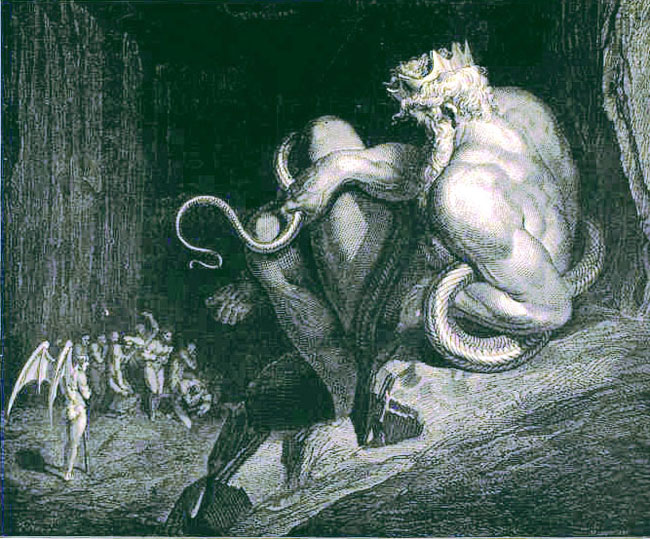
I am reminded of Dante’s Minos:


Gustav Doré's impression of Minos, 1890
Stavvi Minòs orribilmente, e ringhia:
essamina le colpe ne l'intrata;
giudica e manda secondo ch'avvinghia.
Dico che quando l'anima mal nata
li vien dinanzi, tutta si confessa;
e quel conoscitor de le peccata
vede qual loco d'inferno è da essa;
cignesi con la coda tante volte
quantunque gradi vuol che giù sia messa. (Inferno V.4-12)
Minos crouches in the second circle, “horrible and growling”, examining the sins of all who come before him and, by the number of times he curls his tail, indicates the circle to which divine judgement condemns the sinner. Enacting God’s justice, he nevertheless remains monstrously other – an infernal other, not divinely elevated. He points doom with that least human organ, the tail, rather than the hand with which God made the world. Similarly, a loving God is not directly responsible for the horrors visited on the saint or meted out against his/her tormentors (as the saint does not instruct the fiends to punish the pagans); but nevertheless they remain part of a greater divine plan.

It seems to me this view of the fiend serves two functions: reassurance and permission.  On the one hand, the fiend is not active in the world without the supervision of God: these torments, while physically horrific, not only guarantee the saint a place in God’s presence but are ordained by God, who ultimately has control over the situation, over the worst of what happens to us in life.  On the other hand, by token of the first, the martyrdom is an act of God and may therefore be venerated, obsessed over, fetishised, depicted, relished as a work of literature or art. It creates and defines an acceptable way of looking, for images like this:


The flaying of St Bartholomew; Bibl. Nat. MS n. a. fr. 16251 fol. 67v. Le Livre d'images of Madame Marie, c. 1300.


[1] Note that in Agnes’ case the punishment is prompted not by her action but by action against her. I may have to collect a larger sample group to observe whether this is usually gendered. Cf. St Vitalis, whose death is the precipitating factor; though I think I would argue that for a saint martyrdom is an action, potentially the moment of their greatest power.
[2] Upon which, they kill him. At his own request. And the provost weeps for him. Saints are peculiar.
[3] And in Jerusalem, technically, thanks to Lucifer and his superspeed travel. And I’d just like to say that, if refusing the suggestion that you throw yourself off a tall building is a qualification for divinity, I manage to do that every day. Well, I would if more people suggested it to me on a regular basis. I think I would make a relatively sensible deity.  Though some sects might carry out pogroms in the name of correct use of punctuation and antecedents.

Cited:
Caviness, Madeline H. Visualizing Women in the Middle Ages: Sight, Spectacle, and Scopic Economy. Philadelphia: University of Pennsylvania Press, 2001.
Dante. Inferno. Ed. Giorgio Petrocchi. Società Dantesca Italiana, 1994.

Saturday, December 26, 2009

Word made flesh #1

Now this is interesting.

The story is that of the Levite’s concubine from Judges (King James and Latin Vulgate): 
Judges 20.4: I came into Gabaa, of Benjamin, with my wife, and there I lodged: 5 And behold men of that city, in the night beset the house wherein I was, intending to kill me [volentes me occidere], and abused my wife with an incredible fury of lust [incredibili libidinis furore], so that at last she died. 6 And I took her and cut her in pieces, and sent the parts into all the borders of your possession: because there never was so heinous a crime, and so great an abomination committed in Israel. 7 You are all here, O children of Israel, determine what you ought to do.
According to the earlier narrative, the men who came to the house desired not to murder him but to rape him.  The host, reminiscent of Lot, offered his virgin daughter and his guest’s wife rather than the guest: “I will bring them out to you, and you may humble them, and satisfy your lust: only, I beseech you, commit not this crime against nature on the man” (“educam eas ad vos ut humilietis eas et vestram libidinem conpleatis tantum obsecro ne scelus hoc contra naturam operemini in virum”, Judges 19.24).  When she returned to the host’s house and fell dead on the threshold, her husband took her and cut her into twelve pieces, which he sent “into all the borders of Israel” (Judges 19.29.  The outrage summoned the Israelites, whom he addressed as above; and war was the result[1]. This is an image of the key scene from a 13th century Bible Moralisée (sadly blurry):

Österreicheische NationalBibliotecke Codex Vindobonensis 2554 fol. 65v, copied from Caviness 148.

The upper two images are of the corpse being brought home on an ass, and then being divided for distribution.  The lower two are of Jerome and Augustine helping Lady Philosophy  down from the ass of paganism, then giving the twelve books of the Patriarchs to the apostles.

But note the very deliberate visual parallels.  The corpse and Philosophy are helped down from the ass, Philosophy drooping in a way that imitates the inertia of the corpse.  As the corpse is dismembered into twelve parts for demonstrative distribution about the land, Philosophy is fragmented into twelve books to be distributed via the apostles.  Even the divided body parts are very flat and square, resembling images of the parts than the parts themselves, and lacking the curves that usually mark the feminine.

So the books are directly glossed as the dismembered body parts, which are themselves implicitly converted to relics and offered for idolising perusal, their femininity negated.  The female body of Philosophy, meanwhile, appears to have been constructed entirely of the books into which she is fragmented (and she has no more agency of her own, even when intact, than does the corpse). Word is made flesh – just as the words in the books are written on the dismembered flesh of the sheep who kindly donated the parchment.

This also raises the question of the female body as text.  It is not an autonomous text, however, but glossed, interpreted and directed by men – and the written word itself is essentially a male-dominated medium, so in converting to words the body that had temporarily escaped the Levite’s control, he reasserts his ownership and control. It becomes a commodity to be distributed according to the gift and will of its owner, with no more meaning than he chooses to assign it.  The woman’s experience of rape is not heard, only the man’s experience of theft.

Nevertheless – the woman has become Philosophy, and distributed to the inspiration of men’s intellect.  Grammatically feminine, of course, so she must be depicted by a woman, but it’s not a bad reincarnation for a gang-raped concubine, surely?


[1]   Which I’m sure was a great comfort to her.


Cited: Caviness, Madeline H. Visualizing Women in the Middle Ages: Sight, Spectacle, and Scopic Economy. Philadelphia: University of Pennsylvania Press, 2001.

Sunday, October 11, 2009

The Gilte Legende and disjointed saints.

There are the saints everyone knows. They tend to have a well-defined life story, usually set in a particular place and time in history, a collection of miracles done before and/or after their death, and a particular personality and purview that leads to them being called on for certain things (patron or not).

Then there are the saints who are essentially a collection of folklore and local associations, or blends of one and another, Christianised versions of a couple of incidents from classical mythology with some half-remembered local story mixed in and tacked on to the name of someone who might be a regular saint or might be a duplicate or no one at all, really. And these ones rather tend to fail on the whole coherent narrative front.

Most of the stories in the Gilte Legende are actually somewhere between these two categories. Nicholas, for example, is well known and well defined and doesn’t stand much danger of being confused with anyone else. But the events of his life are more a series of vaguely connected events than any coherent narrative; and over a third of the space devoted to him in the Gilte Legende[1] is a conglomeration of miracles[2] attributed to him that took place after his death, which are essentially two stories repeated with slight variants, or at least miracles organised along two common themes (whence his popular personality):

  • A Christian debtor attempts to cheat a patient Jew, who brings him to judgement. The Christian hands the Jew a staff, swears that he has given the Jew the money he owes him, then receives his staff back. He goes free, but is hit by a cart which kills him and breaks open his staff to reveal the gold inside. Men advise the Jew to take the money, but he refuses and says that he will only do so if the dead man should come to life again by the power of St Nicholas. This duly happens, and the Jew is christened.
  • A Jew takes an image of the saint and keeps it in his house, charging it to keep watch over his goods. When thieves break into the house and steal everything but the statue, the Jew “bette [the image] and tormented it cruelli” (Nicholas ll. 244-45), and the wounded saint, appearing to the thieves and berating them for getting him thumped, so terrifies them that they return everything they stole. And everyone lives happily ever after – ie, the thieves become righteous and the Jew becomes a Christian.
  • Nicholas raises a dead child to life, after the sorrowing father berates him for neglecting to protect a family who was so devoted to the saint.
  • A man prays to St Nicholas that he might have a son, promising to give the son and a gold cup to the church. The child being of age, the father has a cup made, decides he likes it too much to give it up, has another of equal weight and value made, and offers that instead. He travels to the church by boat, and commands his son to bring him water in the first cup, upon which boy and cup fall overboard and are lost. Arriving, he offers the second cup, but it is thrown down from the altar three times. Then the child appears, with the first cup, and claims to have been saved from the sea by St Nicholas. The father, rather prudently, offers up both cups.
  • A child is born, again by Nicholas’ intervention, and his father builds a chapel to Nicholas in gratitude. The king takes the child into service, and on St Nicholas’ feast day the child misses his home, knowing how his father would be celebrating it. Standing before the king and holding a rich cup he bemoans this, and the king declares that “for ought þat þy Nicholas can doo þou schalte abide here now” (ll. 305-6). And of course Nicholas immediately poofs him back home to his father. Or possibly he was born in Normandy and kidnapped by the sultan while overseas (Crusading? Serves him right), who liked to beat him, particularly on Christian saints’ days, for some reason. But praying to St Nicholas on that saint’s day, and thinking of the joy at his house on that day, he awakes to find himself in his father’s house again.
Despite the fact that he apparently has popular, wide-spread, firm associations for many people, Nicholas remains thematically disjointed. The Jew has little to do with the child, and neither has any obvious parallel in the story of his life. One can argue similarities between the miracles. For example, the theme of guarding possessions and the possibility of covetousness appears in both Jew stories and the second child story, and the cup appears in the third but has lost its narrative function. The grieving father in the first child story berates Nicholas in a way that seems similar to both Jews exhorting Nicholas to return them their possessions, providing a link to the idea of the child as property to protect to the other stories. But the connection is a tenuous one and no more convincing than, I daresay, one could make between almost any collection of stories attributed to multiple saints.

Saint Nicholas, however, looks like a picture of unity compared to Saint Makary. Here’s what he gets up to:

  • It begins “Makarie went oute of a place of desert and entred [in] the sepulture of a dede man and leyed his hede downe vpon the dede bodi in stede of a pilow” (St Macarius ll. 1-3). No, there is no context or motivation or preamble – why do you ask? A fiend with nothing better to do decided to scare him and made the dead body speak. Makary “dred hym nothyng” (l. 7), but instead beat the body up, which made the fiends flee and is probably exactly what Jesus would have done.
  • This one time Makary was heading for his cell and met a fiend who told him he couldn’t attack him because of his humility.
  • When Makary was feeling troubled by temptations, he used to take a sack of gravel and go walking in the desert, of which he said to Theosebe (no, we aren’t told who he is) “I slee hym that sleith me” (l. 22).
  • Once he met a fiend who was tempting his brethren with wine. And he asked the fiend which of them was succumbing, and the fiend told him Theotist. And so Makary talked to him and told him that wasn’t such a good idea, and next time he met the fiend, the fiend was rather piqued that Theotist was now holier than all of them.
  • Once he found a severed head and had a chat to it about where its soul was.
  • While going into a “ferre desert” (l. 50) he dropped rosary beads to mark his way, probably figuring that this sack of gravel was really heavy and the birds wouldn’t eat rosary beads. But a devil gathered them up and put them next to his head, which just goes to show that birds are secretly evil.
  • Once he advised a brother who was considering leaving his cell not to do so!
  • Once he killed a flea for biting him, or possibly a fly, and then repented and went to live naked in a desert so lots of flies could bite him.

See what I mean? The only common threads are that sometimes he talks to dead people and that he likes a nice masochistic stroll in the desert. I think I like him.

The entry for St Julian the Hospitaller is disjointed in a rather different way [3]. The author is confronted with the fact that there are, in fact, six or possibly seven different Julians that his audience may be familiar with (not to mention St Juliana), and the only way they can be distinguished is by their stories. So he tells all the stories, while insisting that his focus is on the Hospitaller – although only 64 lines out of 218 are actually about that man. To summarise:

  • Julian was bishop of Emans, and people claim he was Simon the leper that Jesus healed. And people say that this is the Julian that people pray to for safe harbour, but they would be wrong.
  • There was another Julian of Auvergne, who was beheaded by the provost Crispin.
  • There was also another Julian who was the brother of… well, a Julian. They built a church and made people stop and help them work on it and smote people who tried to trick their way out of it.
  • Then there was the Saint Julian that we were going to talk about, who killed his own mother and father out of ignorance when they were his guests. Which is why we pray to him for safe harbour. He saw the error of his ways, you see.
  • Also there was Julian the Apostate who did nasty things to Christians. But he was not a saint. Saint Basil smote him. Do not get any of the other Julians confused with him. No, not even the one who killed his guests who were also his parents. He didn’t mean to.

And of course, when dealing with saints, there’s always the really literal meaning of disjointed. One could probably make a very complicated connecting argument out of the disjointed nature of the tales reflecting the torn-up bits of martyrs scattered hither and yon, sometimes over an entire country (or beyond, thank you Pardoner). It’d be a bit of a reach, because it assumes some kind of overreaching cultural intent behind these stories – authorial intent pretty much goes out the window when you’re just collecting a bunch of stories from all over the place and trying to work out how they fit together without changing them much.

Although, come to think of it, from one angle it’s not that far-fetched – if it’s about possession and example, which end up being the same thing, just with different intents of proof. As for example: the physical limbs of a martyr (or traitor, as I wrote about once before) can be strewn over a wide range to provide an example to as many people as possible, from the point of view of their enemy, and to prevent their reassembly come Judgement Day. But for the sympathetic, or the faithful, their very triumph over the latter obstacle is proof of their power, and their power is by the same token disseminated over a wider range, letting more villages and provinces lay claim to a bit of a saint - or a bit of the saint’s stories. And in many cases, the post-mortem perambulations of the persecuted in popular legend may be due precisely to the pressures of possession – we have a bit of his arm bone in our reliquary, his head was carried through this very town on the way to its burial, Bertha’s great-grandmother had a friend who touched the cloak of the person carrying his ashes towards Rome. And, well, if so many people from all over the place can lay claim to him, he (or his bits) must have really got about.

Of course, in many cases, it’s just that the stories were never whole in the first place. And that cutting fictional people up is fun.

-------------------

[1] Following Hamer’s two-volume edition, EETS 327-328, 2006-2007. Of the entry on St Nicholas, ll. 1-199 are his life, 200-319 later miracles.

[2] What's the collective noun for miracles?

[3] The actual story of Julian’s life, when we reach it, is conversely as perfectly structured a narrative as one could wish for. I may look at it in another post.

Wednesday, November 19, 2008

The unseen butterfly; or, Thoughts on the space between the literal and the allegorical

This is a reflection written for the end of our Mediaeval Body course. It takes for granted a certain definition of 'the mediaeval body', and refers implicitly and explicitly to the class readings over the course of the semester. Consequently, there's no explanation of these references in the course of the essay, and, except for direct quotes (and a reference to The Book of Vices and Virtues, which wasn't on the reading list), nothing is footnoted. To make this more comprehensible for a blog post, I've added a separate set of footnotes, explaining the references. The numbered footnotes are in the original reflection; the lettered ones are just for this post.

The reflection is a response to a quote from Michael Camille: "In this period long before the Cartesian split between mind and body there was much more of a continuum between the two. The body was the receptor and receptable of sensation and crucial in the process of cognition. All knowledge, even that of the divine, had to be channelled through the body."


The Unseen Butterfly

The Book of Vices and Virtues describes the liar as “a butre-flye, þat lyueþ by þe aier and haþ no þing in hire guttes but wynd, and at euery colour þat sche seþ sche chaungeþ hire owne”.1 It is not an isolated image: Lorens d’Orleans’ carefully explicated catalogue of the seven deadly sins is full of references to sinners not merely as animalistic, but almost literally as animals. The lines between what is literal and observable in the world and the allegorical understanding of the literal can be seen to shift and blur in the late mediæval period, sited most strongly on the symbolic interpretation of the body. Camille’s understanding of the body as “receptor and receptable of sensation and crucial in the process of cognition” and of the consequent necessity of channelling “all knowledge, even that of the divine”2 through the body is particularly relevant here. The most potent and challenging ideas in the mediæval world, as well as ideas trivial and comic, could be expressed and understood most powerfully – most viscerally – when located on the physical body. Over and over, mediæval writings demonstrate the need to literalise the abstract, in particular to experience it through the body in order to make it understood, to own it or perhaps even to control it.

The observation of real butterflies has little place in Lorens d’Orleans’ allegorical depiction. Such a metaphor today would draw scepticism, because we hold the image of a literal butterfly as a separate naturalistic definition in our minds, and expect a good metaphor to mimic it. There is an echo of appropriateness in the fact that butterflies come in a variety of colours and will instinctively seek out perches against which their particular array will camouflage; but they will not change colour themselves, and neither Lorens nor his audience can possibly have seen them do so. The accepted fact of changing colour, then, was an attribute not of the observable butterfly, but one that belonged to the communal imagination. Lorens’ butterfly is an almost purely allegorical creature, appropriate to the liar because she3 feeds on air – on words – and has no power “in hire guttes” but that same air, her body mutating of necessity to suit her changing circumstances. Other animals to which he compares sinners – pigs, hyenas, mermaids – are described in similar terms. The mundane, exotic and fantastic are all colourful symbols rather than worldly creatures, creatures that inhabit the bestiary rather than pigsty or hedgerow. Lorens’ animals are not products of the literal. His pigs do not behave like mundane pigs, but recall the Gadarene swine “in tokenynge þat glotouns þat leden here lif in glotonye as swyn, þe deuel haþ power to entre wiþ-ynne hem and drenche hem in þe see, þat is to seye in helle”.4 They are memorable, repulsive, even amusing reminders of the effect of sin on the sinner. Conversely, the phrasing in which the traits of the animal are applied to the sinner is strikingly literal: almost invariably a metaphor, not a simile. The effect of this is to reinforce the message of inhumanity and degradation that results from each sin described, no less true for being allegorical and unobservable in the real world. The mirroring of the bestial state of mind in the bodies of the sinners thus becomes a way of observing the ‘real’ truth about sinners.

Gerald of Walesa provides a more literal depiction of bestial human bodies. Claiming true physicality for his werewolves, ox-men, man-women, deformed children and other monsters, he repeatedly invokes his own observations as authority. Insisting on preserving the littera of his account of Ireland’s people, he nevertheless engages with the allegorical when he attributes all these deformities to the moral deficiencies of the Irish.5 Similarly, his accounts of individual creatures, though often sympathetic, lend themselves easily to moral allegory reminiscent of Lorens’ depiction of humans reduced by their actions to the level of beasts. He himself glosses his account of the woman who had “bestial intercourse” with a goat, for example, to say that the woman proved herself “more a beast in accepting him than he did in acting”.6 The real Irish thus become, via Gerald’s pen, a people whose (supposed) primitive morals and essential foreignness make them fascinating but subhuman, the monsters that live among them simultaneously result, punishment and symbol of their moral state. If Mittmanb is correct, Gerald’s History and Topography of Ireland is, on the one hand, an attempt to externalise and explore his own hybridity, and on the other to recast himself as a member of society by defining an ‘other’ far more monstrous and alien than himself. Accounting for his ambivalent attitude towards the creatures he describes, this suggests that the act of writing was for Gerald both a means to understanding his own mixed-race body and his place in the world, and to use images of the deformed body and mind to manipulate his readers’ understanding of what true otherness meant.

To turn from the sub-human to the divine: the cult of Sainte Foyc, like that of many another saint, was primarily a practical one. Her physical presence in Conques served to answer the everyday needs of their bodies – assistance with pregnancy, healing or freedom of prisoners. The concern of her flock for their own bodies is matched by the concern they project onto the saint for her ‘body’ - the anthropomorphic jewelled reliquary containing her mortal remains. Bernard of Angers narrates stories of the man who refused to worship her image, and the girl who refused to stand up as it was carried by, together with the punishment inflicted on them by the saint “as if [they] had shown disrespect for the holy martyr herself”.7 Bernard’s narration of the village’s direct and practical tales is coloured by his theological education, and his anxiety to demonstrate that the cult conforms with accepted church standards. Close identification of the saint with her ‘body’ is a crucial element in defending Conques from the charge of idolatry: the image is not worshipped as an idol, but for the martyr it represents. The physical form of the statue, though valuable, is understood by the devout to be less important than what it contains and symbolises. While the literal, observable statue is for the villagers a means to access the saint and comprehend her sanctity, it also has the potential to be a distraction. Bernard eliminates this possibility by (literally) incorporating it, isolating it within the story of a man who made that mistake. The fool who wished the statue would shatter in order that he might snatch the fallen jewels becomes an example of wrongful understanding of the relationship between the observable and the mysterious. He is justly punished, bodily humiliated for concentrating on the physical body to the exclusion of the spiritual.

Mediæval attitudes towards death also show a complex interchange between literal and allegorical understandings of the body. Death as a literal experience was never far away from the susceptible body, nor was it distant as a metaphorical realm. According to Camille, “the body was not thought to be truly dead, its spirit separated from the body, until a year after burial. Only when all the flesh had left it and it was nothing, nobody, was it ‘Death’”. The body itself thus bridges an uneasy gap between life and non-existence, a gap which could be transgressed in other ways: the intercession of dead saints for the living via the physical remains of their bodies (such as Sainte Foy), the categorisation of lepers and the religious as ‘dead’ to the world, or stories in which people could walk from the ordinary world into the realm of the dead with their own fleshly feet. The metaphorical death of the leper, priest or nun was enacted on the living body to bring the symbolic as close as possible to the literal. A new monk, for example, was required to close himself for three days in a cloister as Christ did in his tomb, before joining his brothers in his new ‘life’.9 More dramatically, a leper’s seclusion office includes hearing mass under a black cloth “after the manner of a dead man, although by the Grace of God he yet lives in body and spirit”, and having a spadeful of earth cast on each foot by the presiding priest in a symbolic burial.10 All wore clothes physically denoting the special status of their body.11 Similarly, Owein’s journey to Purgatoryd does not appear to be unnatural or impossible. The trials are difficult – many men have died attempting them – but not beyond the strength of a truly virtuous Christian who can keep his mind on his divine guide. Like the pilgrim Dante, he walks from this world into the next in his own body, insisting like Dante on the literal truth of the allegorical journey. Believing the story of either descent requires the capacity to subordinate the observed state of reality to the allegorical, but the potential for a literal interpretation strengthens the emotional effect of the story. Everyday humans do not typically stroll into Purgatory and back; but the possibility of such a literal crossing (even if fantastic) makes death seem perhaps a little more controllable, more understandable.

Owein also confronts the apparent paradox that all the souls he sees are fully incorporated, experiencing horrible torments visited on bodies which they ought no longer possess. This is hardly unexpected, however. Torments inflicted on some incorporeal spirit are difficult to comprehend and carry no power, and would therefore lose any relevance as an allegory. The mediæval spirit, moreover, cannot be satisfactorily separated from the body. Even at the moment of death, the moment of that very separation, it is often depicted wafting from the physical mouth in the shape of a miniature copy of the body it is departing. If the soul is the self, and the self is located in the body, soul and body are inextricable. Any torments visited on the soul must be therefore comprehended through the suffering of that body, even in Purgatory or Hell, with all its leaking fluids, piteous moans and susceptibility to pain and damage. The power of such an allegory can be seen in the accounts of holy women like Christina Mirabilise who underwent (or were said to undergo) these pains literally during life, enacting or experiencing in their own bodies in life what they understood to be a literal reality awaiting those bodies in death.

Here, of course, the distinctions between the allegorical and the literal blur into little more than a personal judgement call; as they must, given their overlapping nature. To a culture that believes in the physical reality of Hell, of divine intervention, of the Host changing imperceptibly but literally into flesh, the narrower tag of “observable” is nonsense. But the distinction is important, even if it serves only to demonstrate the relative unimportance of the observable in the mediæval Christian world, a world overlaid with symbolism and ordered by an invisible power. Allegory and physical reality were interdependent: literalisms in allegory served to explain what one could observe literally in the world or in one’s self. What is a real butterfly to that? There were, indeed, truths considered literal that were too mysterious to be appropriate for human observation. Paradise is one: Owein is prevented from entering the final gate because he is not ready. Transubstantiation is another, as Aquinas so painstakingly explains: though Christ is literally there, “since the way [he] exists in this sacrament totally transcends nature, his body can be seen only by God’s own mind and the blessed in heaven with whom he shares the vision. Men can know it in this life only by faith”.12 And orthodox priests seem to have been horrified at the twelfth-century depiction of the Trinity appearing to Abraham with three headsf – despite the fact that the metaphor it embodied was one the church itself insisted was literal.

It would be a difficult and ultimately fruitless task to try to determine just how literally any of these metaphors was believed. The answer, no doubt, would vary from person to person, culture to culture and generation to generation. Did the discrepancy between Lorens’ butterfly and the butterfly on the twig really bother anyone? Did people eye priests over sceptically and mutter mutinously that anyone could see they weren’t actually dead? Aquinas’ care to explain the exact mechanics of transubstantiation, and Bernard of Anger’s defensiveness about the possibility of worship being transferred from idea to idol, suggest that the boundaries between observation and allegory could be and sometimes were problematic. However, the beauty of allegory is that it allows – indeed, requires – belief and understanding of the world on multiple levels at once. In an era fascinated with self-exploration, the observable butterfly is of limited interest; but the allegorical butterfly provides an opportunity to explore the relationship of the physical human body to the world, and vice versa. The continuum between mind and body allowed things that were real purely in the mind – the imaginary, the allegorical, the divine – to be translated and understood through the medium of the body, in order to return them more real to the imagination. There is therefore no absolute neat division between the literal and the imagined: both frequently spilled out into the space between them in which meaning could be explored. If the three-headed Trinity had the capacity to shock the conservative with its literal embodiment of a spiritual metaphor, the fact that it existed at all shows that the space between the two extremes was at once fruitful and fascinating to the mediæval mind.

1 The book of vices and virtues: a fourteenth century English translation of the Somme le roi of Lorens d'Orleans, ed. W. Nelson Francis, Early English Text Society OS 217 (London: Oxford UP, 1942), 60

2 Michael Camille, ‘The image and the self: unwriting late medieval bodies,’ in Framing Medieval Bodies, eds. Sarah Kay and Miri Rubin (Manchester & New York: Manchester UP, 1994), 94.

3 Considering the treacherous mutability of the feminine body in mediæval thought, the gendering of the butterfly as feminine may well be deliberate. As the French “papillon” is masculine, the use of “elle” or “sche” is unlikely to be an accident of grammar.

4 Vices and Virtues, 47.

5 Gerald of Wales, The History and Topography of Ireland, trans. John J. O’Meara (Harmondsworth: Penguin, 1982), 181.

6 Gerald of Wales, Topography, 75.

7 The Book of Sainte Foy, trans. Pamela Sheingorn (Philadelphia: Pennsylvania UP), 79.

8 Camille, ‘The image and the self’, 84-85.

9 Paul Binski, Medieval Death: Ritual and Representation (New York: Cornell UP), 58.

10 Peter Richards, The Medieval Leper and his Northern Heirs (Cambridge: D. S. Brewer, 1977), 123.

11 Lorens d’Orleans extends the metaphor from the body of the priest to that of the sinner when he speaks of backbiting, saying that those who slander “þe goode holy men of religioun” who are “dede as in þis world” are themselves transformed into “þe felle and wikkede best þat men clepeþ heyene, þat goþ and delueþ vp dede bodies of folke and eteþ hem” (Vices and Virtues, 59).

12 Thomas Aquinas, Summa Theologiae: A Concise Translation, ed. Timothy McDermott (London: Eyre and Spotswood, 1989), 578.


a Gerald of Wales, The History and Topography of Ireland, trans. John J. O’Meara (Harmondsworth: Penguin, 1982). Gerald of Wales writes of his travels in Ireland, telling of the strange ways of Ireland. Cocks crow at a different time, snakes are not poisonous, children are often deformed or weak, there are werewolves and other odd creatures, etc. He is particularly (and sympathetically) interested in the monstrous hybrids he met there – several creatures, half human and half beast, which are all the results of humans copulating with animals, because the Irish are so degenerate. He himself is half Welsh, and his mixed blood seems to have led to discrimination against him during his lifetime.

b Mittman, Asa Simon, “The Other close at hand: Gerald of Wales and the ‘Marvels of the West’”, ed. Bettina Bildhauer and Robert Mills, The Monstrous Middle Ages,(Cardiff: University of Wales Press, 2003), 97-112. Mittman speculates that Gerald’s own hybridity led him to attempt to assert his essential similarity with the English by providing through his writing an example of a race far more alien than himself.

c The Book of Sainte Foy, trans. Pamela Sheingorn (Philadelphia: Pennsylvania UP, 1995). Bernard of Angers is the author of several of the documents in the Book, particularly the miracle tales in which he, a theologically educated man and a convert to the cult of Sainte Foy, tries rather defensively to justify the worship of the rich jewelled golden statue that contains her relics by recounting stories of the miracles that Sainte Foy has delivered to the community of her worshippers in the town of Conques – including punishing anyone who doesn’t treat her reliquary with due respect.

d ”The Knight Owein’s Journey through St Patrick’s Purgatory”, ed. John Shinners, Medieval Popular Religion 1000-1500: A Reader (Ontario: Broadview, 1997).

e ”The Life of Christina the Astonishing”, ed. E. Spearing, Medieval Writings on Female Spirituality (Harmondsworth: Penguin, 2002). Christina the Astonishing really is. After leading a quiet life as a virtuous shepherdess, she dies, then subverts expectations by flying out of the coffin at her funeral and perching on the rafters of the church. After this she refuses to be normal. She regularly flits about, perches on roofs and in trees, can’t abide the smell of humans, flees into the wilderness, is chained up by her despairing family and miraculously escapes, curls herself up into a ball of flesh regardless of trifles such as bones and sinews, and feeds herself on her own milk. She also takes up throwing herself into burning ovens, drowning herself, hanging herself and inflicting lots of painful tortures on her body, all of which heal instantly, though she screams in pain. The narrator tells us that she does this because God has promised her that her pain in this life will alleviate that of souls burning in Purgatory, and allow them to ascend to heaven faster.

f A twelfth-century image of the Trinity appearing to Abraham, depicted as an enthroned angel with three heads. Reproduced in Camille, “The image and the self”, 73.