Middle English Word of the Moment

Showing posts with label legenda aurea. Show all posts

Friday, March 5, 2010

The Tale of Zeus and Dame Ragnelle

No, it will make sense. Bear with me.

So, I’ve a conference next week at which I’m speaking on The Weddynge of Sir Gawain and Dame Ragnelle, a mid-15C analogue of the Loathly Lady tale that also appears in, for example, Chaucer’s Wife of Bath’s Tale. The fact that the conference theme is “Intimacy: Family, Friendship and Fealty” means that I can’t just go haring off after the diversion that occurred to me last night, so: once more unto the blog!

The history of the Loathly Lady figure relative to Irish sovereignty tales (in which the lady represents the country) has been well established.  I have no citations by me, as I am writing this on the bus, but I believe Frederick Madden had something to say about it in his collection of Gawain stories, and it goes on from there according to the usual patterns of late 19-early 20C myth-discovery.  That is, therefore, the accepted mythical ancestor of the figure, and as hunting out mythological precedents is rather out of fashion and the genealogy is well traced I don’t believe  anyone has thought to dispute it, or posit any additional ancestor.

But surely the obvious classical precedent is the god-who-comes-to-dinner? Zeus, or some other god (usually Zeus as the patron of hospitality), disguises him/herself as some ugly, poor old beggar and asks for shelter and food. Or, of course, for help crossing a river, etc.  This is a test, the protagonist responds according to their moral stature, and the god suddenly sheds his unprepossessing exterior to reveal himself in all his glory to pass judgement on the protagonist, along with appropriate reward or punishment.  I don’t recall offhand whether any examples of that trope appear in Ovid, but it’s entirely in keeping with the system of virtue and reward evident in the Aeneid, to consider just two of the most culturally influential classical texts extant in the Middle Ages.

The main linking device is, of course, the transformation: a disguised stranger who appeared unworthy according to the ideals of the genre – poor and old and helpless in Greek mythology, disgusting and unmannerly and often old in romance – is suddenly transformed into the epitome of those ideals. In addition:

  • the transformation is in direct response to the actions of the protagonist towards the stranger,
  • in entering the narrative, the stranger will, explicitly or otherwise, initiate a kind of test for the protagonist, in which their response demonstrates (and thereby establishes) their virtue,
  • the stranger retains to him/herself the authority to pass judgement on the protagonist’s actions after the return transformation (rather than delegating that task to the narrator), claiming the status of moral arbiter of the narrative,
  • similarly, the stranger him/herself dispenses punishment or reward.
The trouble with this is that it’s a bit of a jump from Greek mythology to mediaeval romance.  And there is a good deal of cultural filtering and reconditioning that must take place there to make any Greek story (or figure) have any relevance to a late-mediaeval audience.

So where else can we find a more immediate precedent to this figure, a precedent that provides a type of bridging device between classical myth and late-mediaeval readership? a precedent in a tradition that is entirely accustomed to absorbing classical and/or pagan stories and recasting them to its own set of moral values?

Well:
... whanne Seint Iulian reste hym aboute midnyght al forweried [weary] and the wedyr colde and a gret froste, he herde a vois that wepte piteously and cried: 'Iulian, helpe me ouer for Goddes loue or ellis I perische for greuous colde.' And whanne he herde that voys he arose al sodenly [immediately] and passed the colde water and founde that pore creature that deied nigh for colde, toke hym up and bere hym to his hous and light the fere and dede al his diligence to warme hym. And as he myght in no wise make hym take warmthe he toke hym in his armes and bare hym to his bedde... And a litell after he that apered to be so sike and as a foule lepre stied vp shinyng into heuene, saieng to his oste: 'Iulian, oure Lorde hathe sent me to the, sendyng the to saie that he hathe receiued thi and ye bothe shull reste in oure Lorde witheinne a litell tyme' And anone he vanished awaye... (Gilte Legende, ed. Richard Hamer, EETS 2006; v. 1, 144)
Appropriately enough, that comes from the story of St Julian Hospitaller, Zeus’ descendant in the role of protecting the sacred laws of hospitality and defending the safety of guests.  But it works perfectly well in a Christian context, thus refigured – well enough that throughout the Gilte Legende (and elsewhere), saints and even Jesus himself regularly pop up where they’re not expected, mysteriously disguised, usually as someone helpless, and initiate a test of some kind or another.  Quite of a piece with the popular belief that saints really could interfere in a very material way with everyday life – all your big brothers are watching you.

So, if Dame Ragnelle has cross-genre precedents in, for example, St Julian and others, can we expect that her contemporary audience might have recognised them and picked up on the currents? I think so – if nothing else, Ragnelle seems to deliberately play with the collision of genre, pushing herself forcibly into society, conscious of her own incongruity and playing it for all it’s worth with her fine clothes and horse.  If so, the audience could expect her at her appearance to make demands which would set up a challenge as a moral test – apparently for both Arthur and Gawain. And she does, tests which Gawain passes and Arthur fails (largely by fobbing responsibility off on his nephew).

But if she refers to or recalls testing figures in hagiography, does this have an effect on what is being tested? Courtly virtues? Christian ones?  The story of St Julian explicitly opposes the life of the court (and its values) with the humble Christian values that  attend helping mysterious sick strangers (for which you have to live in an isolated hut beside a ‘flode’). The Wife of Bath’s nameless loathly lady gives a pillow-lecture that could be read as being in opposition to ‘courtly’ virtues. And Gawain, when his ugly wife has become beautiful, thanks God for her deliverance from a curse (and presumably for his from the equally horrible fate of having to look on her all the time). Perhaps Arthur’s failure is that he tries to adhere to courtly virtues which are (or could be read as) so dependent on appearance as reflective of personal status.

Monday, January 4, 2010

The fiend as God’s sergeant (part 2/2)

And if the fiend functions as God’s – executor, as it were – carrying out God’s will to the greater glory of the saints while managing to be evil himself (because apparently God has great PR officers), what can we say about these lads?  This is the torture and mastectomy of St Agatha, and I think I may venture to hypothesise that the two at her with pliers are EVILEVILEVIL. Look at their faces – they’re approaching the fiendish themselves[1].

Bibl. Nationale, MS n. a. fr. 16251 fol 87v. Le Livre d'images de Madame Marie, c. 1300. Image taken from Caviness 82.

Hassig has written a chapter on specific details of mediaeval portrayals of Jews/monsters/others/foreigners/devils, all of which elide rather tellingingly at some point.  If I recall[2], there were several things that functioned most strongly in depicting evilother, among them distorted faces, grimaces, crouching posture, tightly curled hair and dark skin.  All of these features are not only present in these unpleasant-looking lads, but accentuated by contrast in every case to the serene, upright, very pale figure between them. So they are associated, not only by narrative function but by visual language, with the actions of the devil.  Standing in for him in the physical performance of Agatha’s martyrdom, they take on physical attributes associated with him – but also, of course, with themselves as ethnically other.

So Christianity’s tendency to create enemies [3] comes in handy here – we have a sliding scale between foreign and devil, between not-us and persecutor and enemy of God, where the only difference between foreigner, pagan, idol, demon and Satan is  of degree.


As the corollary to this, what does Agatha resemble in this picture? Well, in context, that’s rather obvious – who stands around looking bright and benevolent while surrounded by tormentors, with arms stretched out to either side of his head?  And is a complete contrast to devils? In case we missed the similarity, she has her convenient halo to point it out.  There is also a clear sexual difference – she is pure and white and fully clothed (save where they have exposed her body for humiliation and torture) with skirts to the ground, while their legs are bared and the violating instruments are held in a suspiciously phallic position.

Physically, she is approaching (literally) Christ – she is raised above her tormentors, as if halfway to heaven.  And alright, so she has breasts and that’s not entirely Christ-like – but hey, her tormentors are (sergeant-like) removing those for her, so that won’t be a problem for much longer.   Remove those curves, and she would be almost entirely masculine in appearance. 

Of course saints are often depicted as resembling Christ, or rather partaking of the same visual code of virtue and holiness, just as the torturers resemble the devil. But a female saint is visually farther from Christ to begin with, and it’s hardly illogical that she should become masculinised in depiction in the process of approaching him[4].  Caviness has mentioned the tendency towards masculinisation in the tortures visited on female martyrs - Agatha’s isn’t the only mastectomy, and the torments often appear to result in a masculine display of physical courage or fortitude, etc (Caviness 90).

I’ve described it as purely visual, but of course the cultural attitudes are hardly limited to the pictorial. Though Caviness is primarily discussing images, rather than literature, she implies that this tendency is also present in the shape of the stories of the female martyrs: “The threat of the female is expunged by her becoming masculine (or female-less) in response to bodily exposure and torture.  The repetition of the mastectomy topos in so many saints’ lives, possibly by a borrowing from one to the other, is an indication of its cathartic power” (93). 

But doesn’t this imply that ‘female’ is something expunged from the body to leave a pure male remaining? Yet the feminine is already defined by its lack relative to the male body, so logically in lacking both masculinity and femininity one becomes genderless.  Is there, then, a similar tradition (though fainter, I think) in the purification of male saints by castration? I can’t think of nearly so many instances, but one could construct an idea of an idealised non-gendered spiritual body, purged of sex. 

Of course, this is rather too (theo)logical and rather less fundamentally attractive than the idea of ripping off women’s breasts or ‘improving’ the bodies of admired women until they resemble men (the best of men), so it’s not likely to have such a wide currency in popular stories.


[1] Cf. the faces of the people flaying St Barthlomew (from the same ms) in the picture at the end of the last post: one's turning his head away, one looks uncomfortable, and one looks like he's positively enjoying himself.  All three are similarly dressed to Agatha’s tormentors, and the face of the third is the most distorted. 


[2] Unfortunately I haven’t read this article for over a year and my photocopy of it is in Canada and I can’t source it over here in Adelaide, but I shall sharpen the specifics as soon as I get back to Ottawa. I don’t think my memory misrepresents her.

[3] It's ridiculous, isn't it? given the cultural dominance of Christianity for, oh, 1700 years, its insistence on a neurotic self-representation as a persecuted minority. Childhood really is a very formative time, apparently for religions as well as people. It is a very attractive self-representation too, isn't it - it means you needn't mature emotionally beyond that childhood phase of ranting at injustice and being misunderstood, and may construct enemies everywhere at a moment's notice. After all, you're the victim, right?


[4] This raises a question, which I’m not addressing now because I’m really just thinking aloud (well, on a screen): Are any female martyrs depicted in a Marian code, rather than a Messianic one? I can’t think of any, and it’s less intuitive – but are the unmartyred female saints depicted consistently in the visual tradition of Mary, then? Is there an appreciable divide there?


Cited.
Caviness, Madeline H. Visualizing women in the Middle Ages: Sight, spectacle and scopic economy. Philadelphia: U. of Pennsylvania P., 2001.
Hassig, Debra. "The iconography of Rejection: Jews and other Monstrous Races". Image and Belief: Studies in the Celebration of the Eightieth Anniversary of the Index of Christian Art.
Ed. Colum Hourihane. Princeton: Princeton University Press 1999. 25-46.

Saturday, January 2, 2010

The fiend as God's sergeant (part 1/2)

In the medieval narratives [of female martyrs] good girl and bad girl alike were stripped only to mortify the flesh, whether at the behest of an evil emperor or of Satan, who oddly enough carries out the punishments to which sinners are condemned by God. (Caviness 85)
Well, but it isn’t odd. At least according to the pattern of the Gilte Legend (which, incorporating as it does many different versions of many different stories from many different traditions, rarely has a pattern but does manage one in this case), infernal intervention in saints’ lives is always associated with the pattern of divine will. Fiends enact God’s purpose, both in demonstrating the saint’s glory and in performing divine vengeance on sinners. They get the dirty work, but their actions tend to God’s ends. Of course, from a narrative point of view, every character and action in a moralistic short story point towards the same moral end; but the articulation (by narrator, saints and fiends) of the fiends’ purposes show a deliberate unity between infernal and divine intentions.

I’ve only a few pages of the Gilte Legende with me here in Adelaide, and none have examples of Satan or fiends explicitly involved with a martyrdom (though, as I mention in my next post, they’re there ‘in spirit’ in the person of the tormentors). But of the eight pages I have (well, sixteen – eight photocopies of facing pages), there are enough consistent references to fiends to generalise about their behaviour – and they are far from autonomous.

When the son of the provost who sent St Agnes to the brothel goes to visit her there (presumably with rape in mind, given he takes a gang of his friends along), he is foiled by a/the fiend acting in concert with heavenly light:
And whanne he wolde haue touched her the bryghtnesse of the light come ayeinst hym, and he yelded no worshippes ne thankyngges to God, wherfor he was anone strangeled of the fende. (110)
“Strangled by the fiend” (“strangled” can mean “smothered” or even just “killed”) seems almost a figure of speech (though of a piece with the literal behaviour of fiends elsewhere), until Agnes explains to his father that yes, in fact, agency in that act does belong to the devil, and is due explicitly to the boy’s choice of him over God:
He of whom he wolde fulfell the wille toke pouer vpon hym and slough hym, and whanne his felawes sayn the miracle of God thei turned ayein all dredfulli withouten any harme. (110)
Moments like this in which fiends punish sinners usually occur as a direct result of some action by the saint[1] (though notice that the saint does not instruct the fiend to do so):
[St Longinus] toke an axe and braste doun all þe ydollis... And þe fendis þat wente oute of þe ydollis entrid into the [evil] prouost and within his felawis, and þay al torente hemself as madde men and knelid doun to Longius. (212)
Longinus then removes the devils and restores the men to sanity[2]. Similarly,
... the preste of the idoles that hadde geue his counsell [to kill St Vitalis] was anone rauished withe the fende and was verray wood .vij. dayes and cried in the place wher Seint Vitall was buried: ‘Allas, Vitall, how thou brennest me.’ And in the .vij.te day þ fende threwe hym in the riuer wher he deied cursedly”. (284)
Even when not punishing the saint’s tormentors, the fiends invariably (so far as I can recall) take action solely for the benefit of the saint – the moral and demonstrative benefit, that is, even if they humiliate his/her body. They enable the saint to either ascend to a higher moral plane, or (more commonly) to demonstrate his/her moral/spiritual superiority and the power consequently given him/her by God.

The demonstration, of course, works on two levels: to other characters in the narrative, and to the reader. Some incidents are designed more for one audience than the other: proof aimed at the world of the narrative often involves very public confrontation or spectacular miracles, as in the previous examples, while those aimed at the reader need not be witnessed by other characters, and are more likely to recall stories of Christ’s actions or passion.

Macarius, for example, is tested privately, “in the supulture of a dede man” in “a place of desert”, recalling Christ’s temptation in the wilderness[3] and his entombment (possibly also the harrowing of Hell). The fiends who find him have no purpose but “to make hym afraied”, and Macarius’ imperviousness causes them to flee, helpfully informing the audience as they go that he has “ouercome us”. Another more violent fiend later tries to attack him with a scythe, “but he myght not”. Macarius need not even speak to deter this fiend, as he is simply and mysterious impervious. This fiend is also handily explicit in not only demonstrating Macarius’ moral superiority, but explicating its nature to the reader:
And thanne he saide hym: ‘A, thou Makarie, thou makest me to suffre gret violence, for I may do nothyng ayeinst the. And I doo as thou doost, thou fastest and I ete not, thou wakest and I slepe not, but one thing is wherin thou ouercomest vs most.’ Thanne the abbot saide: ‘Wherin is that?’ And the fende saide: ‘Humilitie, wherfor I may do nothyng ayeinst the.’ (93)
The place of the fiend in these tales is very ordered.  It cannot be a true enemy, with motivations and agenda of its own, nor can it pose a real threat to the saint or to God’s plan.  Though malicious, it acts only within God’s plan, and can have effect only against those who have already committed themselves to the devil by actions against God or God’s proxy.  Attempted action against that proxy serves only their aggrandisement – and the fiends not only seem to know this, but sometimes get quite chatty with the saints about it (Longinus is another such).  They may have rebelled originally against God, but they seem incapable of rebelling against their place as it is now in the natural order. 

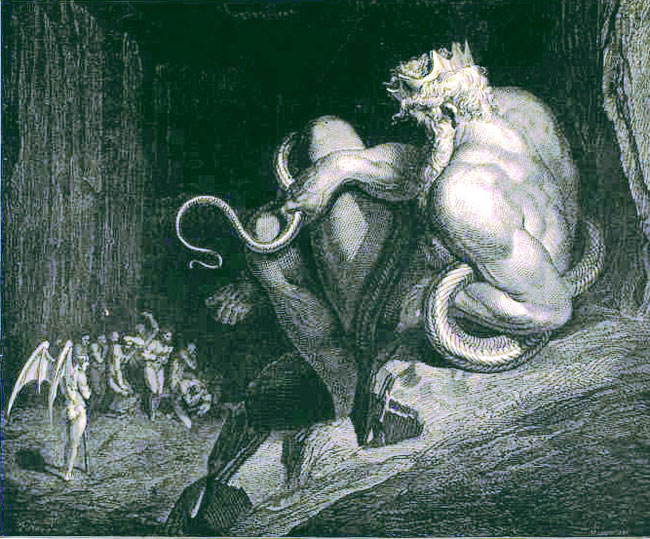
I am reminded of Dante’s Minos:


Gustav Doré's impression of Minos, 1890
Stavvi Minòs orribilmente, e ringhia:
essamina le colpe ne l'intrata;
giudica e manda secondo ch'avvinghia.
Dico che quando l'anima mal nata
li vien dinanzi, tutta si confessa;
e quel conoscitor de le peccata
vede qual loco d'inferno è da essa;
cignesi con la coda tante volte
quantunque gradi vuol che giù sia messa. (Inferno V.4-12)
Minos crouches in the second circle, “horrible and growling”, examining the sins of all who come before him and, by the number of times he curls his tail, indicates the circle to which divine judgement condemns the sinner. Enacting God’s justice, he nevertheless remains monstrously other – an infernal other, not divinely elevated. He points doom with that least human organ, the tail, rather than the hand with which God made the world. Similarly, a loving God is not directly responsible for the horrors visited on the saint or meted out against his/her tormentors (as the saint does not instruct the fiends to punish the pagans); but nevertheless they remain part of a greater divine plan.

It seems to me this view of the fiend serves two functions: reassurance and permission.  On the one hand, the fiend is not active in the world without the supervision of God: these torments, while physically horrific, not only guarantee the saint a place in God’s presence but are ordained by God, who ultimately has control over the situation, over the worst of what happens to us in life.  On the other hand, by token of the first, the martyrdom is an act of God and may therefore be venerated, obsessed over, fetishised, depicted, relished as a work of literature or art. It creates and defines an acceptable way of looking, for images like this:


The flaying of St Bartholomew; Bibl. Nat. MS n. a. fr. 16251 fol. 67v. Le Livre d'images of Madame Marie, c. 1300.


[1] Note that in Agnes’ case the punishment is prompted not by her action but by action against her. I may have to collect a larger sample group to observe whether this is usually gendered. Cf. St Vitalis, whose death is the precipitating factor; though I think I would argue that for a saint martyrdom is an action, potentially the moment of their greatest power.
[2] Upon which, they kill him. At his own request. And the provost weeps for him. Saints are peculiar.
[3] And in Jerusalem, technically, thanks to Lucifer and his superspeed travel. And I’d just like to say that, if refusing the suggestion that you throw yourself off a tall building is a qualification for divinity, I manage to do that every day. Well, I would if more people suggested it to me on a regular basis. I think I would make a relatively sensible deity.  Though some sects might carry out pogroms in the name of correct use of punctuation and antecedents.

Cited:
Caviness, Madeline H. Visualizing Women in the Middle Ages: Sight, Spectacle, and Scopic Economy. Philadelphia: University of Pennsylvania Press, 2001.
Dante. Inferno. Ed. Giorgio Petrocchi. Società Dantesca Italiana, 1994.

Wednesday, December 23, 2009

Cleopatra D IX: MS V, ff. 118-168. South English Legendary.

A fragment of an otherwise unknown manuscript of the South English Legendary.


Description.

Parchment, 51 ff., 265 x 165 mm with the text block 205 x 112 mm. Written in one column of 40 lines. Folios in twelves, with ff. 1-5 of the first quire lost and the final quire in eight. The last leaf is blank. Written in two hands, both Anglicana approaching textura, very clear. B is rounder with smaller strokes. A writes ff. 118-149v (John Evangelist, Thomas of Becket), B ff. 149v-166 (Theophilus/Virgin, Cecilia, Gregory). No decoration save the “traditional blue initials flourished in red with marginal extensions”, not filled in (Görlach, Textual tradition 112). All folios but the last numbered in modern foliation.


Contents.

The end of a manuscript of the South English Legendary, lacking at least five leaves from its first quire and probably several other quires containing a more complete collection of the poems. The South English Legendary is a popular collection of saints’ lives in vernacular verse, surviving in many manuscripts, originating in the Worcestershire/Gloucestershire region in the late thirteenth century. Görlach observes that it seems to have been confined to this region “for the first 50-80 years of its existence, spreading into the Midlands only in the second half of the 14th century” (Revision 9). The legends contained in this manuscript are (Brown 267-68):

- 118r: The final eight lines of St John the Evangelist (Him sende here his ringe a3en & þonked him also...). ½ p.

- 118r-149v: St Thomas of Canterbury, followed by his Translation (Gilberd was Thomas fader name þat trewe was & god...). 32 ff.

- 149v-155v: St Theophilus, with Miracles of the Virgin (Seint Teophle was a gret man & gret clerk also...). 7 ff.

- 155v-158v: St Cecilia (Seint Cecile of noble kinne ibore was at Rome...). 4 ff.

- 158v-166v: St Gregory (All þat beoþ in sinne i-bounde / And þencheþ godes merci to abide...). 9 ff.


Origin.

Görlach’s study of the dissemination and variations of the Southern English Legendary, together with the dialect and orthography of this version, led him to place it in the Gloucestershire/Oxfordshire region (Görlach, Textual tradition 112). Its acquisition by Prise may suggest a religious house in Gloucestershire, as he enacted the dissolution of many houses there and apparently none in Oxfordshire (cf. Pryce; Ker, Sir John Prise), although there is no evidence that he acquired it directly from its original location rather than from another collector.


Date.

Görlach judges both hands in this manuscript as belonging to the middle of the fourteenth century.


Later provenance and position within codex.

At some point during the sixteenth century the manuscript, or possibly its remains, fell into the hands of Sir John Prise, employed by Henry VIII during the 1530s to close down monasteries in the west of England (Ker, Sir John Prise 5). Prise’s aversion to altering or rebinding the manuscripts in his collection (ibid) suggests that it would have passed on to Cotton (presumably via one or more intermediaries) alone, unbound with any other manuscript within the codex. The gap in foliation between the previous manuscript and this, however, suggests the presence of two blank leaves, possibly used by Prise to enclose this fragile fragment to prevent the loss of further leaves (if indeed it was fragmented at this point).

While Prise may have been more concerned with the preservation of the original state of his manuscripts than many of his contemporaries, his attitude was not entirely reverent. Ker mentions the “numerous, strongly Protestant and anti-Becket” notes in Prise’s hand written in the margin by that legend: “What arrogance is this! of one that had spent his tyme more in merchandize hauking and hunting than in lernyng” (qtd. in Ker, Sir John Prise 21). Precious his books may have been to Prise, but ultimately utilitarian.

There is also the possibility that Prise may have received the manuscript intact. This is perhaps more likely: history was his subject, not the vagaries of poetic saints, and a mere fragment of such a text might have not seemed worth preserving. If, then, it passed on to Cotton as a whole and was fragmented by him (see introductory post), he may have bound it with another two leaves to distinguish it from the ‘serious’ matter of the volume, or to hold it together pending proper binding. This is another question on which the manuscriptitself could shed light, as the age and wearing of the outer leaves of the manuscript and of the sheltering leaves ought to give some clue as to how long each has spent unprotected.


Lacunae.

Perhaps fittingly, considering its position as the final manuscript in the codex, this manuscript’s value as a witness lies less in its contents than in its later history. The poems it contains, with minor variations, survive in more complete manuscripts and have been published several times, while their cousins and progeny live on in texts such as the Canterbury Tales and the Gilte Legende. On the other hand, its treatment at the hands of Prise (and possibly Cotton) stands with the fate of the psalter in Royal 13 D I in testimony to the likely fate of a good many such manuscripts at the hands of the Protestant antiquarians. The violence visited on the ‘body’ of this manuscript seems to evidence a need to correct and subdue a recalcitrant creature amongst the diligent, precious subjects better beloved of their keepers. As such, the mystery of its missing leaves and the firm rebukes written in its margins form an appropriate counterpart to the quiet survival of the Brief Chronicle, and to the repeated studying and reproduction of the Liber Alani de Ashbourne.


Cited.

Brown, Carleton. A Register of Middle English Romance and Didactic Verse. Oxford: Oxford UP, 1916.

Görlach, Manfred. The textual tradition of the South English Legendary. Leeds: University of Leeds, 1974.

----- An East Midland Revision of the South English Legendary: A Selection from MS C. U. L. Add. 3039. Heidelberg: Carl Winter, 1976.

Ker, Neil R. “Sir John Prise”, The Library 5th series 10 (1955): 1-24.

Pryce, Huw. “Prise, Sir John (Syr Siôn ap Rhys) (1501/2–1555).” Oxford Dictionary of National Biography. Oxford UP, 2004. 03 Dec 2009.

Tuesday, November 10, 2009

Structure and symmetry in the Gilte Legende (1): St Julian


So, a couple of weeks back I discussed the disjointed nature of some of the vitae in the Gilte Legende (ed. Richard Hamer, EETS OS 327-8, 2006-7). I also mentioned the plethora of stories of Julians that the author tells under the entry for St Julian (v. 1 pp. 141-47) just to make sure we know which St Julian is the right St Julian; but despite the generally confused nature of that entry, the story of St Julian itself is beautifully symmetrical, and his saintly functions relate perfectly to the events of his life.

Briefly, the story is this. Fleeing a prophecy that he will kill both his parents (laid on him as punishment by a hart he was hunting), he moves away, marries and conveniently gets set up as a lord in a nicely feudal castle, as happens to so many unconnected vagabonds. When his parents find his castle, his wife invites them in, realises who they are, lavishes hospitality on them and gives up her bed to them, going to sleep elsewhere for the night. Returning home, he sees a man and a woman in his wife’s bed and kills them both in a fit of jealousy. As he emerges from the bloody chamber he meets his wife emerging, pointedly, from the chapel, and is slightly chagrined to hear her explanation. Realising that “whan I wende to eschewe this sorifull dede I most cursed haue fulfelled it” (144), he flees his castle and society and goes hermit – with his wife, who refuses to desert him. “And thanne they went togedre besides a grete flode where many men perisched, and there besides in that desert thei made a litell hospitall for to do there penaunce and for to bere ouer all tho that wolde passe” (ibid), until one day a horrible slimy smelly old leper turns up and says HELP ME ACROSS THE RIVER. Well, given the Greek-myth heritage of this story which has already been so obvious I didn’t even bother to use the word Oedipus anywhere, we know how this bit goes. He helps the leper, takes him in and feeds him and, because he's dying of cold, “toke hym in his armes and bare hym to his bedde and hilled hym diligently” (ibidetc). And lo and behold, the leper is secretly an angel sent by God to receive his penance and promise him that he will be taken to God soon. Incidentally, that “hilled” is probably “healed” but could also mean “cover, wrap” and possibly “embrace”. So perhaps it’s not surprising that if he was cuddling a leper (who probably had flu, and also fleas) in his bed, it was only “a litell after” that he and his wife both “slepten in oure Lorde Ihesu Crist”.
Just like Sir Gawain, this story invites diagrams. So:


No, I'm not procrastinating, why do you ask?
The story is driven by three revelations, each following an action of Julian’s. Pursuit of the hind leads to a prophecy, the murder of his guests is followed by the revelation of their identity and charity to the leper is followed by the revelation of the angel. In turn, each revelation leads to a journey:

I COULD continue to elaborate this picture and add all the other little structural things mentioned below and more, but I don't think Paint would let it be legible after another two lines or so.
Interestingly, the first two journeys are principally away, fleeing a prophecy and his shame respectively. It is only the third journey, instigated by God, that is a journey to a specific destination. Also, the first journey would seem to be in an upwards direction: socially, he ascends, and topographically he ends up in a nice tall castle which is presumably on some sort of a hill. But the folly of this social and earthly ascension is revealed by the consequences of his (newly acquired?) social pride, when his jealousy leads him to murder. The next journey is deliberately downwards, through the social scale and to the banks of “a grete flode”, and it is here that the spiritual state is reached which allows him to ascend correctly in the end. Or, to put it another way, his initial quest is away from his birth identity, now revealed as dangerous, to one which is more socially pleasing and validated by the community but leads to grave sin through a lack of his own self-knowledge (failing to recognise his parents), and thence towards social obscurity that leads him to discover a purer and truer identity in God.
There are other pleasing little contrast-dualities happening in the structure:

  • Most obviously, Julian’s attitude to his guests changes from the initial monstrous misunderstanding of his duties as host (and son) to his parents, to the self-sacrificing devotion he shows to an unfamiliar leper (who stands in for his spiritual father). There are shades of a similar guest in the hart, not recognised by Julian even as human until it speaks, and thereby foreshadowing his slaughter of his parents.
  • Wilderness vs. culture, where the first (initial forest, final flood) bracket the second and seem to be places of truth and self-knowing, while the second causes obscurity of the soul and blinds with frivolous things.
  • More specifically, the bedroom vs. the church. Note that, while Julian was in his bedroom being murderous, lustful, prideful, greedy et al, his wife was in the church, dutifully at her morning prayer after being beautifully hospitable and giving up her bed to the guests. Both emerge from their respective spaces of darkness and light at the same moment, and it is the sight of her that initiates the revelation of Julian’s error (“and whanne he seigh her he hadde mervaile”, 144), removing his blindness.
  • His wife has a pleasing sense of symmetry also, promising to stay with him in good time and in bad, “for sethe I haue parted with you in ioye I shall be partener of your sorw”. Their impending departure (and de-part in Middle English could also mean divide) “parts” the story into two, and there is a sense that her presence and her “part” in his fate will be a decisive factor in making this a clean break, providing a sort of rebirth.
  • The initial promise of the hart is echoed and laid to rest in the promise of the angel, the first predicting dire acts and bloody division from his parents, the second imminent peace and reunion with his heavenly father.
So, all in all, a very clever little example of certain elements from classical legend rewritten comprehensively enough to a) not feel patchy and disjointed and b) seamlessly rewrite the messages to a mediaeval Christian moral setting.

    Sunday, October 11, 2009

    The Gilte Legende and disjointed saints.

    There are the saints everyone knows. They tend to have a well-defined life story, usually set in a particular place and time in history, a collection of miracles done before and/or after their death, and a particular personality and purview that leads to them being called on for certain things (patron or not).

    Then there are the saints who are essentially a collection of folklore and local associations, or blends of one and another, Christianised versions of a couple of incidents from classical mythology with some half-remembered local story mixed in and tacked on to the name of someone who might be a regular saint or might be a duplicate or no one at all, really. And these ones rather tend to fail on the whole coherent narrative front.

    Most of the stories in the Gilte Legende are actually somewhere between these two categories. Nicholas, for example, is well known and well defined and doesn’t stand much danger of being confused with anyone else. But the events of his life are more a series of vaguely connected events than any coherent narrative; and over a third of the space devoted to him in the Gilte Legende[1] is a conglomeration of miracles[2] attributed to him that took place after his death, which are essentially two stories repeated with slight variants, or at least miracles organised along two common themes (whence his popular personality):

    • A Christian debtor attempts to cheat a patient Jew, who brings him to judgement. The Christian hands the Jew a staff, swears that he has given the Jew the money he owes him, then receives his staff back. He goes free, but is hit by a cart which kills him and breaks open his staff to reveal the gold inside. Men advise the Jew to take the money, but he refuses and says that he will only do so if the dead man should come to life again by the power of St Nicholas. This duly happens, and the Jew is christened.
    • A Jew takes an image of the saint and keeps it in his house, charging it to keep watch over his goods. When thieves break into the house and steal everything but the statue, the Jew “bette [the image] and tormented it cruelli” (Nicholas ll. 244-45), and the wounded saint, appearing to the thieves and berating them for getting him thumped, so terrifies them that they return everything they stole. And everyone lives happily ever after – ie, the thieves become righteous and the Jew becomes a Christian.
    • Nicholas raises a dead child to life, after the sorrowing father berates him for neglecting to protect a family who was so devoted to the saint.
    • A man prays to St Nicholas that he might have a son, promising to give the son and a gold cup to the church. The child being of age, the father has a cup made, decides he likes it too much to give it up, has another of equal weight and value made, and offers that instead. He travels to the church by boat, and commands his son to bring him water in the first cup, upon which boy and cup fall overboard and are lost. Arriving, he offers the second cup, but it is thrown down from the altar three times. Then the child appears, with the first cup, and claims to have been saved from the sea by St Nicholas. The father, rather prudently, offers up both cups.
    • A child is born, again by Nicholas’ intervention, and his father builds a chapel to Nicholas in gratitude. The king takes the child into service, and on St Nicholas’ feast day the child misses his home, knowing how his father would be celebrating it. Standing before the king and holding a rich cup he bemoans this, and the king declares that “for ought þat þy Nicholas can doo þou schalte abide here now” (ll. 305-6). And of course Nicholas immediately poofs him back home to his father. Or possibly he was born in Normandy and kidnapped by the sultan while overseas (Crusading? Serves him right), who liked to beat him, particularly on Christian saints’ days, for some reason. But praying to St Nicholas on that saint’s day, and thinking of the joy at his house on that day, he awakes to find himself in his father’s house again.
    Despite the fact that he apparently has popular, wide-spread, firm associations for many people, Nicholas remains thematically disjointed. The Jew has little to do with the child, and neither has any obvious parallel in the story of his life. One can argue similarities between the miracles. For example, the theme of guarding possessions and the possibility of covetousness appears in both Jew stories and the second child story, and the cup appears in the third but has lost its narrative function. The grieving father in the first child story berates Nicholas in a way that seems similar to both Jews exhorting Nicholas to return them their possessions, providing a link to the idea of the child as property to protect to the other stories. But the connection is a tenuous one and no more convincing than, I daresay, one could make between almost any collection of stories attributed to multiple saints.

    Saint Nicholas, however, looks like a picture of unity compared to Saint Makary. Here’s what he gets up to:

    • It begins “Makarie went oute of a place of desert and entred [in] the sepulture of a dede man and leyed his hede downe vpon the dede bodi in stede of a pilow” (St Macarius ll. 1-3). No, there is no context or motivation or preamble – why do you ask? A fiend with nothing better to do decided to scare him and made the dead body speak. Makary “dred hym nothyng” (l. 7), but instead beat the body up, which made the fiends flee and is probably exactly what Jesus would have done.
    • This one time Makary was heading for his cell and met a fiend who told him he couldn’t attack him because of his humility.
    • When Makary was feeling troubled by temptations, he used to take a sack of gravel and go walking in the desert, of which he said to Theosebe (no, we aren’t told who he is) “I slee hym that sleith me” (l. 22).
    • Once he met a fiend who was tempting his brethren with wine. And he asked the fiend which of them was succumbing, and the fiend told him Theotist. And so Makary talked to him and told him that wasn’t such a good idea, and next time he met the fiend, the fiend was rather piqued that Theotist was now holier than all of them.
    • Once he found a severed head and had a chat to it about where its soul was.
    • While going into a “ferre desert” (l. 50) he dropped rosary beads to mark his way, probably figuring that this sack of gravel was really heavy and the birds wouldn’t eat rosary beads. But a devil gathered them up and put them next to his head, which just goes to show that birds are secretly evil.
    • Once he advised a brother who was considering leaving his cell not to do so!
    • Once he killed a flea for biting him, or possibly a fly, and then repented and went to live naked in a desert so lots of flies could bite him.

    See what I mean? The only common threads are that sometimes he talks to dead people and that he likes a nice masochistic stroll in the desert. I think I like him.

    The entry for St Julian the Hospitaller is disjointed in a rather different way [3]. The author is confronted with the fact that there are, in fact, six or possibly seven different Julians that his audience may be familiar with (not to mention St Juliana), and the only way they can be distinguished is by their stories. So he tells all the stories, while insisting that his focus is on the Hospitaller – although only 64 lines out of 218 are actually about that man. To summarise:

    • Julian was bishop of Emans, and people claim he was Simon the leper that Jesus healed. And people say that this is the Julian that people pray to for safe harbour, but they would be wrong.
    • There was another Julian of Auvergne, who was beheaded by the provost Crispin.
    • There was also another Julian who was the brother of… well, a Julian. They built a church and made people stop and help them work on it and smote people who tried to trick their way out of it.
    • Then there was the Saint Julian that we were going to talk about, who killed his own mother and father out of ignorance when they were his guests. Which is why we pray to him for safe harbour. He saw the error of his ways, you see.
    • Also there was Julian the Apostate who did nasty things to Christians. But he was not a saint. Saint Basil smote him. Do not get any of the other Julians confused with him. No, not even the one who killed his guests who were also his parents. He didn’t mean to.

    And of course, when dealing with saints, there’s always the really literal meaning of disjointed. One could probably make a very complicated connecting argument out of the disjointed nature of the tales reflecting the torn-up bits of martyrs scattered hither and yon, sometimes over an entire country (or beyond, thank you Pardoner). It’d be a bit of a reach, because it assumes some kind of overreaching cultural intent behind these stories – authorial intent pretty much goes out the window when you’re just collecting a bunch of stories from all over the place and trying to work out how they fit together without changing them much.

    Although, come to think of it, from one angle it’s not that far-fetched – if it’s about possession and example, which end up being the same thing, just with different intents of proof. As for example: the physical limbs of a martyr (or traitor, as I wrote about once before) can be strewn over a wide range to provide an example to as many people as possible, from the point of view of their enemy, and to prevent their reassembly come Judgement Day. But for the sympathetic, or the faithful, their very triumph over the latter obstacle is proof of their power, and their power is by the same token disseminated over a wider range, letting more villages and provinces lay claim to a bit of a saint - or a bit of the saint’s stories. And in many cases, the post-mortem perambulations of the persecuted in popular legend may be due precisely to the pressures of possession – we have a bit of his arm bone in our reliquary, his head was carried through this very town on the way to its burial, Bertha’s great-grandmother had a friend who touched the cloak of the person carrying his ashes towards Rome. And, well, if so many people from all over the place can lay claim to him, he (or his bits) must have really got about.

    Of course, in many cases, it’s just that the stories were never whole in the first place. And that cutting fictional people up is fun.

    -------------------

    [1] Following Hamer’s two-volume edition, EETS 327-328, 2006-2007. Of the entry on St Nicholas, ll. 1-199 are his life, 200-319 later miracles.

    [2] What's the collective noun for miracles?

    [3] The actual story of Julian’s life, when we reach it, is conversely as perfectly structured a narrative as one could wish for. I may look at it in another post.

    Saturday, August 16, 2008

    Sacred and profane dismemberment

    At a seminar last Thursday, we were debating the mediaeval cult of saintly relics, which started me thinking about the prevalence of the theme of dismemberment in the Legenda aurea, a thirteenth-century best-seller that gives accounts of the legends attached to saints' lives. Many of the saints, of course, were martyred, and the descriptions tend to be lurid, and heavy on the dismemberment.

    Just for example:


    Sir Thomas Becket, of course, was set upon by four hot-headed young knights who thought to do Henry II a favour: "And then smote each at him, that they smote off a great piece of the skull of his head, that his brain fell on the pavement... And when he was dead they stirred his brain, and after went in to his chamber and took away his goods, and his horse out of his stable, and took away his bulls and writings."

    St Winifred was one of those pious, holy virgins we hear so much of, who told her would-be rapist she'd rather die than betray her incorporeal spouse - "I will in no wise consent to thy foul and corrupt desire, for I am joined to my spouse Jesu Christ which preserveth and keepeth my virginity" - so he obligingly cut off her head. Interestingly, in this case, the head was fixed back on afterwards, bringing her back to life - "And ever, as long as she lived after, there appeared about her neck a redness round about, like to a red thread of silk, in sign and token of her martyrdom."

    St Theodore had a particularly delightful scene. Refusing to recant his religion (and, incidentally, having burnt down the temple of Mars instead), "he was hanged on a tree by commandment of the emperor, and cruelly his body was rent and torn with hooks of iron, that his bare ribs appeared. Then the provost demanded of him: Theodore, wilt thou be with us or with thy God Christ? And Theodore answered: I have been with my Jesu Christ, and am, and shall be. Then the provost commanded that he should be burnt in a fire."

    St James the Martyr found himself in a similar predicament, only longer. They cut up his body member by member, starting with the little finger, asking after each amputation whether he recanted. Instead, he made a parable out of Christian numerology about the number of fingers he had lost, or the significance of this or that part of the body: "Then the seventh finger was cut off, and he said: Lord, I have said to thee seven times in the day praisings.... Then the butchers having despite, cut off the great toe of the right foot, and S. James said: The foot of Jesu Christ was pierced and blood issued out." After some time of this, the Christian was obdurate, but the "butchers" swooned. "And after they came to themselves, and cut off the left leg unto the thigh, and then the blessed James cried and said: O good Lord, hear me half alive, thou Lord of living men and dead; Lord, I have no fingers to lift up to thee, ne hands that I may enhance to thee; my feet be cut off, and my knees so that I may not kneel to thee, and am like to a house fallen, of whom the pillars be taken away by which the house was borne up and sustained; hear me, Lord Jesu Christ, and take out my soul from this prison. And when he had said this, one of the butchers smote off his head."

    And so on. There are many in there. But why the emphasis on tearing bodies apart? I suspect one answer is the simple delight in gory detail which we all know to an ineradicable element of human nature - I'm sure I don't need to quote all the horror films that capitalise on that. There is also, of course, the sympathy factor, getting the audience on side with the good Christians undergoing a type of Christ's death for our sake. Another answer may well be the fact that the stories of martyrs tend to have two distinct themes - the completely unattainable heights of disinterested spirituality, which it is very hard for ordinary humans to relate to, and the gruesome story of their death, acted out in great detail on the physical body in which every human has a share. The horror of the physical ordeal, which we can all at least imagine, is a good deal easier to relate to than the first theme, but the way they are usually interwoven (the torture or threats of it as a result of one's religion, and one's religion as a solace in the torture), perhaps help to draw them together, to make that unattainable perfection of soul a little less daunting to approach.

    There is also a strong symbolic element to most of these accounts - James provides his own allegorical commentary, and the decapitation element of Winifred and Thomas' stories relates to the theme of authority. The struggle between Henry II (theoretically the head of the country) and Thomas as Archbishop (head of the church) over whether secular or religious power should hold sway both justifies the knights' attack on the head of Thomas' physical body, and simultaneously makes it pointless - the spiritual body is what counts. Winifred protests that she is "joined" to her spouse Jesus, and with the husband allegorically believed to be a woman's head, her attacker's choice to strike that off is more than just random pique. She is vindicated by being brought back to life and re-"joined" to that head.

    However.

    Whatever the reasons for gruesome dismemberment in saints' stories, heightening the prestige of the saint, preparing for the relic cult, impressing with their endurance, anything - how does this relate to the mediaeval forms of torture and execution, particularly the hanging, drawing and quartering inflicted on that worst of social enemies, the traitor? As I'm in between the researching and drafting stages of my essay on Edward II at the moment, the images of execution and "let the punishment fit the crime" are rather clear in my head at the moment - particularly as regards Hugh Despencer.

    There is, of course, a good deal of symbolism or allegory involved in the prescribed punishment. Lady Despenser detailed a lot of this in a blog post a month ago. The curious thing is that
    the hanging, drawing and emasculation (possibly an innovation designed especially for Hugh, and allegedly at Isabella's insistence, though I don't place a lot of credence on that) can all be seen as paralleling the purification aspects of saintly dismemberment, by atoning for crime, burning out the sin, amending the soul. However, if the body is then quartered and the quarters separated, as Lady Despenser points out, the person will be unable to reassemble their body come the day of Judgement. In other words, the soul is denied immortality.

    Inconsistent? Perhaps. The gruesomely public aspect of the execution does mean, I suppose, that for the vast majority of people it was essentially retribution and example. It's probably fair to say that the same is true of our justice system today. We do like to think that we focus a little more on the aspect of redemption (or rehabilitation, as we'd put it), that it is in fact an invention of our modern enlightened times; but is it, in fact, present in the symbolism of mediaeval acts of judicial violence, and their disturbing vicinity to the legends of injustices committed on the bodies of saints?

    Or did people just like really violent things? Never discount the lowest common denominator!